Scan & Share: How a Simple QR Code Eliminated Hospital Queues for Millions
By Dr. RS Sharma, Former CEO, National Health Authority of India, Strategic Advisor - Digital Health News.
Picture this: a sick and exhausted patient, who has travelled hundreds of kilometres to reach AIIMS, New Delhi, one of India's finest hospitals. It is 5:00 a.m., and she is already in a queue. By the time the OPD counter opens at 8:00 a.m., the line stretches across the courtyard. She waits, standing, for hours. If she is lucky, she reaches the counter before it closes at noon. The clerk types in her name and details. There are typos. She is turned away to get them corrected. She must return tomorrow and start again. This was not an exceptional story. This was a daily reality for millions of Indians.
A Vision Born in a Pandemic
In May 2020, as India and the World grappled with COVID-19, I presented a concept to the Prime Minister Narendra Modi called the Open Health Systems Network (OHSN). The idea was deceptively simple: create an open, interoperable, standards-based digital infrastructure for health, much like UPI had done for payments. Unbundle monolithic systems, let innovation flow, and put citizens at the centre.
The Prime Minister was receptive. After several iterations, this vision gave birth to the Ayushman Bharat Digital Mission (ABDM), launched by the Prime Minister on 21 September 2021. I had joined the National Health Authority as its CEO in February 2021 and had the privilege of stewarding this mission for two years.
ABDM's goal was ambitious: build a National Digital Health Ecosystem that supports universal health coverage using open, secure, and privacy-respecting digital infrastructure. Its core building blocks included a unique patient identifier, the Ayushman Bharat Health Account (ABHA) number, along with health facility and professional registries, and a consent-based Health Information Exchange that lets patients share their records with doctors of their choice.
The Question That Changed Everything
By 2022, ABDM had registered impressive numbers, particularly the digitisation of COVID-19 vaccination certificates through CoWIN. But we kept asking ourselves a harder question: what tangible convenience does this deliver to a patient on an ordinary Tuesday at their local government hospital?
The answer was not yet compelling enough. We needed a use case that was immediate, visible, and unmistakably useful to an ordinary person.
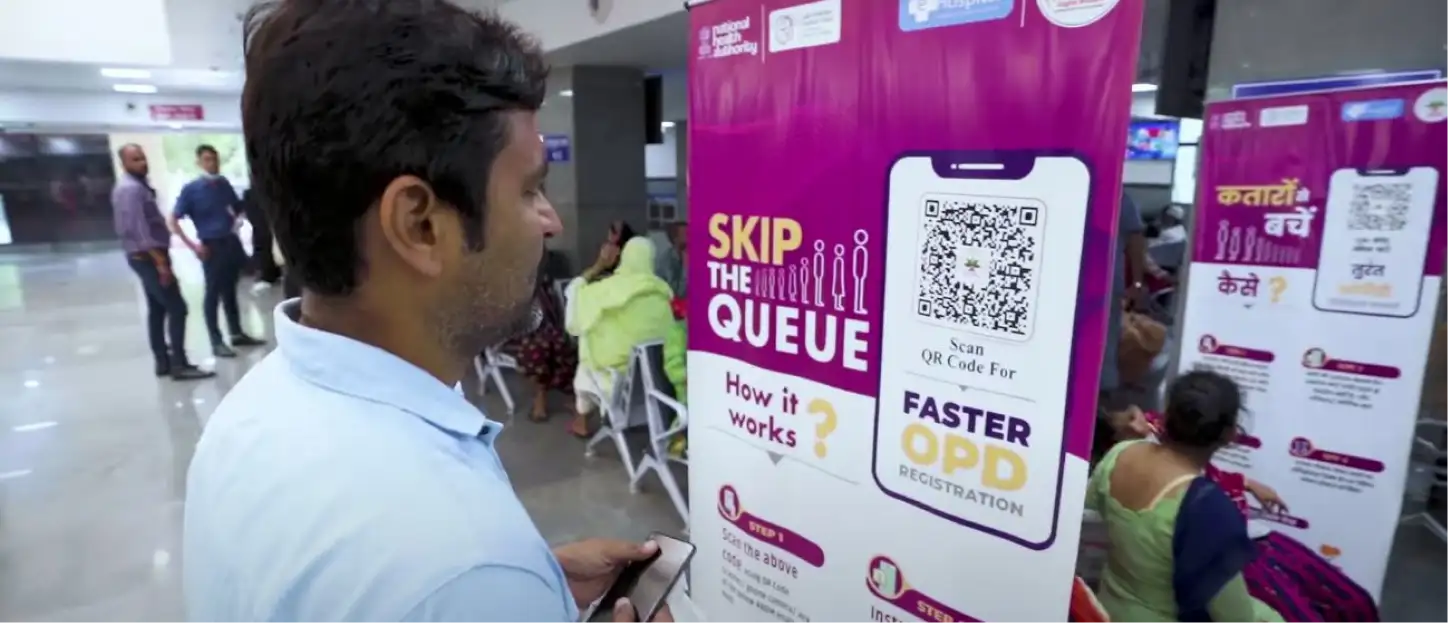
The insight came from a visit to AIIMS. Watching patients queue for OPD tokens, I thought of something familiar to every Indian with a smartphone: scanning a QR code to pay via UPI. What if patients could do something equally simple, scan a QR code at the hospital entrance, share their ABHA details, and receive a token number on their phone? No filling forms. No waiting at counters. No typing errors.
The patient could simply sit in the waiting area or even a chai stall nearby, and watch the running display for their token number, just as one waits for a flight boarding call.
From Idea to Reality: Lady Hardinge & Beyond
We did not wait for a grand rollout. We started small. The team approached Lady Hardinge Medical College & Hospital in New Delhi, a busy government hospital, and convinced the administration to try a pilot. We set up a small booth, helped patients install the ABHA app, created their ABHA numbers, placed QR codes, and modified the Hospital Management Information System (HMIS) to consume the incoming data and issue tokens. As the patient was sharing her demographic information using the QR code scan, we christened it "Scan and Share."
On 12 October 2022, we issued 286 tokens. Our Director, Akshay Jain stood there the entire day, guiding patients. It was modest in scale, but unmistakable in impact. Patients were visibly relieved. The queue at the counter thinned. The clerk made no typing errors because there was nothing to type.
From Lady Hardinge, we went to AIIMS Delhi in November 2022. And then, steadily, the idea travelled on its own merit. We worked with the two dominant government HMIS platforms, eHospital by NIC and eShushrut by CDAC, to integrate the Scan and Share APIs natively. This single decision meant that any hospital using either system could go live with minimal effort.
The Numbers Tell Their Own Story
The adoption has been nothing short of remarkable.
Today, Scan and Share is live across 28,818 health facilities in every State and Union Territory of India. Over 22 crore (220 million) OPD tokens have been issued since inception, with more than 5 lakh tokens generated every single day. States like Uttar Pradesh, Andhra Pradesh, Karnataka, and Jammu & Kashmir have led the way. AIIMS New Delhi alone has processed over 18 lakh tokens through this system.
Approximately 76% of users are accessing the service for the first time, evidence of genuine new adoption, not just repeat usage by digital-savvy early adopters.
Waiting times that previously stretched to an hour or more have been reduced to 2 to 5 minutes. For elderly patients, pregnant women, those with disabilities, and those who have travelled far, this is not a convenience. It is a profound relief.
The service has also expanded to pharmacy and laboratory counters within hospitals, where similar queuing problems existed. Over four lakh pharmacy tokens have already been issued. Plans are underway for Scan and Pay (enabling cashless payments at facility counters) and Scan and Send (allowing patients to share prescriptions and lab reports by scanning a QR code).
The real-time performance dashboard is publicly accessible at: https://dashboard.abdm.gov.in/abdm/scanshare
The dashboard is not fed manually; every data point is generated live as patients scan QR codes across the country.
What This Teaches Us About Technology Adoption
Scan and Share succeeded because it followed a principle I have come to believe deeply: technology that genuinely solves a real problem does not need marketing. It spreads because people tell each other about it.
We did not advertise. We did not mandate. We demonstrated, at a small booth in Lady Hardinge, that scanning a QR code could spare a sick person an hour in a queue. Word spread. Hospitals asked to be onboarded. States started competing on adoption metrics.
There is also a lesson here about architecture. ABDM was designed as an open, interoperable infrastructure, not a closed government portal. Because the APIs were open and standardised, private hospitals, digital solution companies, and state health agencies could integrate rapidly. Because only two HMIS platforms covered most government hospitals, a few key integrations enabled national scale.
And finally, there is the lesson of starting small and learning fast. We did not wait for the perfect system. We took a pilot to Lady Hardinge with what we had, watched it work, and iterated. The first day's 286 tokens grew into 22 crores.
India is demonstrating that digital public infrastructure, when designed around the citizens' most immediate needs, can travel at remarkable speed across a country of 1.4 billion people, across language barriers, income divides, and geographies.
A QR code. A phone. A token number. And a patient who can finally sit down.
That, to me, is what technology in public service should feel like.
For live statistics and state-wise performance, visit: ABDM Scan and Share Dashboard
Stay tuned for more such updates on Digital Health News
Follow us