India Pitches ‘All-Inclusive Intelligence’ Vision for AI in Healthcare at WHO Meet
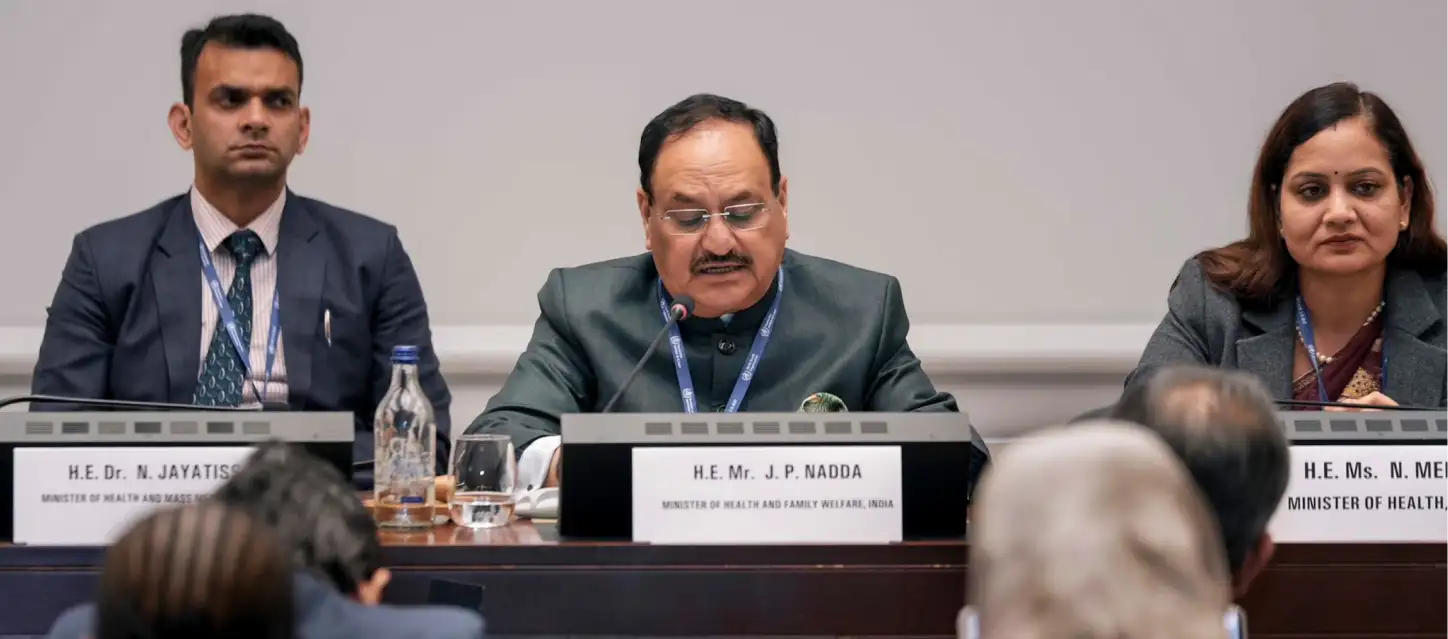
Nadda said India’s position on AI in health is guided by Prime Minister Narendra Modi’s vision of making AI a force for equity, ethics and public good, and he called on global partners to align around human-centric approaches.
India is promoting an “All-Inclusive Intelligence” approach to artificial intelligence in healthcare, arguing that AI must be regulated, ethical and accessible if it is to improve health outcomes, Health Minister J. P. Nadda told the World Health Assembly in Geneva.
Speaking on May 19 at a side event on “Artificial Intelligence in Health: Laws, Ethical Oversight, Research and Equity” during the 79th World Health Assembly, Nadda said AI holds significant potential to enhance healthcare delivery but warned that, without adequate safeguards, it could worsen existing inequalities.
He outlined India’s efforts to ensure that advances in AI benefit people across social and economic backgrounds, building on the Digital India initiative launched in 2015. India now oversees AI deployment for a population of 1.4 billion people across 22 languages and highly uneven healthcare access, he noted.
Nadda said India views AI not merely as “Artificial Intelligence” but as “All-Inclusive Intelligence”, framing the country’s approach as one rooted in public good. He said this vision relies on trusted data ecosystems, collaborative research and strong governance mechanisms to ensure safety, fairness and transparency.
Among recent policy steps, Nadda highlighted the Strategy for AI in Healthcare for India (SAHI), unveiled at the India AI Impact Summit in February 2026. He described SAHI as a “Global South–first” framework intended to guide the ethical and transparent use of AI in health systems.
He also pointed to the Benchmarking Open Data Platform for Health AI (BODH), designed to test AI systems against real-world datasets and benchmark their performance to ensure they meet standards of safety and fairness.
Nadda said India’s position on AI in health is guided by Prime Minister Narendra Modi’s vision of making AI a force for equity, ethics and public good, and he called on global partners to align around human-centric approaches.
On the sidelines of the Assembly, Nadda also presented India’s efforts to tackle tuberculosis at a high-level ministerial panel organised by the Stop TB Partnership, alongside ministers from Japan, the Philippines and Zambia. He cited strengthened screening, expanded treatment coverage and community participation as key elements of India’s TB response.
Nadda met several counterparts and global health leaders in Geneva, including Jamaica’s Health and Wellness Minister Christopher Tufton, with whom he discussed cooperation in digital health, recognition of the Indian pharmacopoeia, and exchange of healthcare workers. He also held discussions with Rt Hon. Helen Clark, chair of the Partnership for Maternal, Newborn & Child Health (PMNCH), and WHO Goodwill Ambassador for Leprosy Elimination Yohei Sasakawa on advancing partnerships in digital health, pharmaceuticals, and women’s and child health.
“The future of AI depends on our collective ability to build ethical and human-centric systems,” Nadda said, urging countries to harness AI as a tool for inclusive and equitable healthcare.
Stay tuned for more such updates on Digital Health News
Follow us