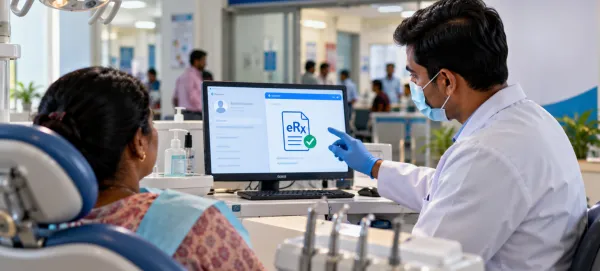
HIMSS26: Enterprise AI, Interoperability, Cybersecurity, & Financial Automation Redefine Healthcare Transformation

AI deployment, interoperability frameworks, hospital financial resilience, and next-generation digital infrastructure dominated discussions at the HIMSS Global Health Conference & Exhibition 2026, where health systems, technology companies, and policymakers outlined how the industry is shifting from experimentation to large-scale digital healthcare deployment.
Healthcare AI Moves From Experimentation to Enterprise Deployment
One of the most prominent themes at the HIMSS Global Health Conference & Exhibition 2026 was the rapid shift of artificial intelligence from experimental pilots into enterprise-grade systems embedded across hospitals, clinical workflows, and operational environments. Several technology providers introduced AI platforms designed to integrate directly with clinical systems and national health data networks.
Amazon introduced Health AI, an agentic health assistant developed by Amazon One Medical and powered by Amazon Bedrock. Unlike traditional symptom-checking tools, the system connects to nationwide health information exchanges and analyzes a patient’s longitudinal medical history to generate personalized triage insights. Eligible Amazon Prime members will also receive access to up to five direct-message consultations, positioning the service as a potential consumer-facing gateway to primary care.
Similarly, Oracle expanded its enterprise clinical AI portfolio with the Oracle Health Clinical AI Agent, designed for emergency departments and inpatient settings. The system extracts triage notes, lab results, and imaging data from electronic health records to generate clinical documentation in real time. Early deployment at AtlantiCare showed a 41% reduction in documentation time, highlighting the potential impact of ambient AI tools on clinician workload.
Adding a broader perspective, Gayle Stidsen Smith, Vice President-IT, Jefferson Health, said, “Taking a moment to reflect on HIMSS26 after all the excitement, reunions, and new connections...
AI was everywhere, of course, but the tone felt different this year. Conversations shifted toward privacy‑first approaches, enhancing rather than replacing, and my favorite theme of all: automate last.
What really stood out, though, is how relationships continue to make this healthcare IT ecosystem feel like a tight‑knit community, 30,000 of my closest friends. It was wonderful to reconnect with colleagues who have become true friends over the years (insert), and energizing to meet new people who share the same passion for leveraging technology to enable better health, strengthen shrinking margins, and inspire the next generation.”
Electronic Health Record (EHR) vendor CharmHealth also launched CharmCopilot, a multi-agent AI assistant embedded within its EHR platform. The tool supports nurse intake documentation, generates physician summaries, and assists with coding and administrative workflows.
Healthcare organizations are also scaling AI internally. The West Virginia University Health System expanded deployment of the Abridge AI platform to more than 2,800 clinicians across 25 hospitals, after internal surveys reported a 61% reduction in cognitive workload and a 77% increase in work satisfaction.
Industry leaders attending the event said the growing ecosystem of enterprise and consumer AI platforms is reshaping how healthcare organizations approach digital transformation.
Anil Saldanha, Chief Innovation Officer, Rush University System for Health, said, “Epic and Oracle Health have launched new AI agents to coincide with Amazon Connect Health, Microsoft Copilot Health, and Google CVS Health Platform. These AI agents and platforms serve the enterprise and consumer healthcare sectors.
Healthcare organizations, professionals, and patients now have options for consumer or agentic AI from traditional EMR vendors, technology/cloud companies, and AI firms, such as OpenAI for Healthcare (ChatGPT Health, ChatGPT for Healthcare), Anthropic (Claude for Healthcare), and Google Gemini.”
EHR Platforms & Multi-Agent AI Architectures Reshape Clinical Workflows
EHR vendors and AI developers used the HIMSS stage to demonstrate how artificial intelligence is becoming deeply integrated into healthcare infrastructure.
Epic Systems reported that 85% of its customer base is actively using its AI suite, which includes tools such as Art, Penny, and Emmie. The company also introduced Agent Factory, a visual platform enabling health systems to design custom AI agents, along with a proprietary family of medical foundation models called Curiosity. One clinical application of Epic’s AI technology has demonstrated a 69% early lung cancer detection rate when analyzing incidental imaging findings.
Meanwhile, MEDITECH introduced ambient listening tools embedded directly within its Expanse point-of-care applications, allowing clinicians to capture documentation automatically during patient visits. The vendor also unveiled Claim Denial Agents, autonomous AI systems that investigate claim denials and generate evidence-based appeals using patient chart data.
Ambulatory care EHR provider Greenway Health launched Novare, a platform built around an AI-first architecture rather than layered automation. Early pilot programs reported that a 10-provider practice saved nearly 14,000 hours annually through automated coding and prior authorization workflows.
Communication platform Zoom also announced that its Clinical Note feature will integrate directly into Epic workflows. The system automatically generates clinical documentation and syncs notes into Epic Mobile Haiku and Hyperspace in less than a minute.
Revenue cycle technology provider R1 RCM partnered with ambient AI scribe company Heidi Health to integrate clinical documentation with financial workflows. The integration ensures AI-generated notes are optimized for coding accuracy, billing, and payer compliance at the point of care.
Research presented by the Mount Sinai Health System further highlighted the benefits of distributed AI architectures. The study found that distributing clinical tasks among multiple specialized AI agents can be up to 65 times more computationally efficient than relying on a single generalized model.
Michael Archuleta, CIO, Mt. San Rafael Hospital and Clinics, added, “After a week at HIMSS26 "Speaking at the AI in Healthcare Forum, participating in HIMSS TV conversations, one thing became very clear: healthcare has entered a new phase of digital transformation. ..At HIMSS26 the tone was very different. Leaders are no longer asking whether AI belongs in healthcare they are asking how to deploy it responsibly, govern it effectively, and integrate it into clinical workflows in ways that give clinicians time back and improve patient care.''
"AI is moving beyond experimentation, cybersecurity is increasingly being recognized as a patient safety issue, and health systems are investing in the foundational elements that make innovation sustainable trusted data, resilient cloud infrastructure, and interoperable platforms that allow information to move where it’s needed most. One thing became very clear walking the floors at HIMSS: the future of healthcare will not be defined by who adopts AI first, but by who deploys it responsibly and integrates it in ways that truly improve care...The organizations that will define the next decade will be the ones that combine responsible AI, trusted infrastructure, and leadership grounded in a simple principle: a patient’s ZIP code should never determine their healthcare outcomes,” the CIO further noted.
Vishnu Saxena, Founder & CEO, ScaleHealthTech and Digital Health News, provided a comprehensive perspective, stating, “One of my key observations from HIMSS26 is the AI evolution. This year, outcome data is everywhere, and Agentic AI is real - the receipts have arrived. For years, people said AI would transform healthcare; now leaders are showing the proof. AI governance is no longer a checkbox; it’s part of the product. When agents start touch patient records, submit prior auths, or draft appeals, accountability is the only question. Vendors building that in from day one will earn enterprise trust. Health system leaders are tired of point solutions. A CIO told me, “We have over 20 AI tools, and I don’t know what half of them do.” They’re not shopping for features; they want long-term partners. AI is now about trust, adoption, and scale, not demos. More broadly, healthcare is moving from digital to operational transformation. Enterprise AI, secure interoperable data, policy enablement, and human-centered innovation are becoming the infrastructure for care delivery, efficiency, and patient engagement.’’
Interoperability & National Data Exchange Frameworks Expand
Interoperability policy and healthcare data exchange remained central to discussions at HIMSS26, with federal leaders outlining how regulatory frameworks and collaborative ecosystems are beginning to converge to enable nationwide data fluidity.
Officials from the Centers for Medicare & Medicaid Services (CMS) and the Office of the National Coordinator for Health Information Technology (ONC) emphasized that the Trusted Exchange Framework and Common Agreement (TEFCA) and the CMS-led Health Technology Ecosystem are designed to work in tandem, balancing structure with speed in advancing interoperability.
“Former U.S. CTO Aneesh Chopra helped convene the annual FHIR Implementers Roundtable at HIMSS26, which historically has focused on recruiting early adopters to test emerging FHIR standards. This year, it featured the CMS Health Tech Ecosystem and efforts to kill the clipboard and unlock consumer-mediated data sharing through CMS-aligned networks, including all TEFCA participants.”
Reinforcing the urgency to simplify access, Dr. Mehmet Oz of CMS said, “One of the most repeated messages from CMS leadership was “Kill the clipboard.” The idea is to eliminate paper intake forms and fragmented data entry. Instead: Patients should scan a QR code when they arrive at a provider. That scan would allow them to instantly share their medical data with the provider..”
Amy Gleason, Acting Administrator, U.S. DOGE Service and Strategic Advisor to CMS, highlighted execution gaps, stating, “We asked a simple question: Why isn’t interoperability working as intended? We have strong frameworks like TEFCA, but in reality, there are still gaps. That’s why the focus now is on execution, bringing stakeholders together with clear six- and 12-month goals to make interoperability actually work.”
This push toward execution is already gaining traction. Since its launch in 2025, the CMS Health Technology Ecosystem has expanded from around 60 organizations to over 700, spanning health IT vendors, providers, payers, and technology firms. The initiative is designed to enable patients to securely access their medical records through digital applications, monitor data access, and strengthen provider-payer exchange through improved access to clinical and claims data, as well as national provider directories.
Complementing these national efforts, regional collaboration continues to play a critical role. During the session “Local Roots, National Reach: Building Federal Health Capabilities Through Community-Centered Networks,” Jennifer Searls, Executive Director of Connie, emphasized that large-scale interoperability must be built on local trust networks.
She added, “Great conversation and an important reminder that national interoperability truly begins at the local level. The trusted relationships built through regional and state HIEs are foundational to advancing collaboration across providers, public health, and communities.''
Virtual Nursing & Workforce Innovation
During the session “Virtual Nursing: Redefining the Bedside Experience through Virtual Innovation,” speakers Katie Nolan, Director of Virtual Health and Language Access Services at Piedmont Healthcare, and Grant Reed, Clinical Manager of Virtual Nursing Operations at Piedmont Healthcare, shared the organization’s rapid expansion of virtual nursing across 17 hospitals and 2,700 beds.
The program emphasized workflow optimization, enhanced nurse support, and improved patient outcomes, integrating virtual care teams with bedside staff to increase efficiency while reducing burnout. The speakers detailed implementation strategies, staff training models, and lessons learned, offering a blueprint for health systems seeking scalable virtual care solutions.
Katie Nolan and Grant Reed said, “The initiative focuses on improving workflows, supporting nurses, and enhancing patient outcomes. The work highlights strong collaboration across teams at Piedmont and will share implementation strategies, lessons learned, and results from their successful program.”
Hospital Finance & Revenue Cycle Automation Gain Urgency
Financial sustainability emerged as another key focus at the conference as hospitals continue to face rising costs and tightening margins.
Healthcare finance startup Translucent raised $27 million in Series A funding led by GV, expanding its AI-powered financial analytics platform. The system continuously monitors operational signals, including physician productivity and claim denials, to identify sources of revenue leakage in real time.
Stamford Health selected Ensemble Health Partners to manage its end-to-end revenue cycle operations using an AI-enabled model designed to consolidate fragmented financial technology stacks.
Hallmark Health Care Solutions introduced AI-driven bill rate intelligence within its workforce vendor management platform to generate market-aligned labor cost recommendations.
Meanwhile, RevSpring launched RevSpring Prime, a platform designed to help healthcare organizations scale direct-to-employer and membership-based care models by automating billing, coverage verification, and patient intake workflows. The company also introduced SeatMate, an AI tool that provides billing staff with real-time prompts and payment plan recommendations during patient financial conversations.
Cybersecurity, AI Governance, & Fraud Prevention Take Priority
As healthcare AI adoption accelerates, cybersecurity and governance are becoming increasingly critical concerns.
Identity security provider Imprivata introduced agentic identity management, a system designed to govern AI agents through role-based permissions, short-lived authentication tokens, and real-time shutdown capabilities.
A joint survey by Healthcare Information and Management Systems Society and network security company Elisity found that 62% of hospitals require microsegmentation to secure Internet-connected medical devices, though many organizations remain hesitant due to concerns about disrupting clinical workflows.
Meanwhile, Codoxo introduced Deepfake Detection, an AI-driven system designed to identify synthetic medical documentation and manipulated diagnostic images submitted in insurance claims.
AI platform Anterior also released a fairness analysis of 7,167 human-reviewed prior authorization cases, demonstrating that its AI decision-support system maintained consistent performance across demographic groups.
Leadership & Organizational Readiness for Digital Transformation
During the session “Scaling Change: A Tiered Strategy for Organizational Readiness,” speakers Michael Collins, Director of Organizational Development at Wellstar Health System, and Gabriel Szaszio, Executive Director of Talent Strategy and Workforce Planning at Wellstar Health System, discussed the human and organizational factors that influence digital transformation success.
They said, "At HIMSS26, discussions highlighted that large-scale healthcare change often fails not because of strategy, but because adoption doesn’t fully occur. By combining leader upskilling with structured internal change support, organizations can better navigate transformation, strengthen leadership capability, and reduce employee turnover. The key takeaway: healthcare organizations must focus not just on implementing change, but on developing leaders who can continuously lead it."
Diagnostics, Robotics, & Emerging Care Platforms Expand
Technology companies also unveiled new diagnostic, robotic, and care-delivery innovations. Philips expanded its HealthSuite Integrated Diagnostics portfolio with a cloud-enabled digital pathology platform built on Amazon Web Services.
Medical robotics firm Able Innovations deployed its ALTA robotic patient transfer platform at Lahey Hospital & Medical Center, enabling a single healthcare worker to safely perform lateral patient transfers while reducing the risk of injury and physical strain.
Stroke diagnostics company Brainomix deployed its AI imaging platform across the West Virginia University Health System network, enabling automated detection of large-vessel occlusions and accelerating stroke treatment decisions across community hospitals. Moreover, Healthcare robotics infrastructure developer Arrive AI introduced the Arrive Point Network, designed to support secure robotic deliveries within healthcare facilities.
Meanwhile, telehealth technology provider GlobalMed unveiled a mobile clinical response platform integrating telehealth capabilities, diagnostic tools, and secure connectivity to expand care delivery in rural and underserved regions.
Turning Point for Healthcare Digital Transformation
By HIMSS26’s conclusion, discussions had shifted from excitement about AI to pragmatic focus on implementation, governance, and measurable outcomes.
According to Sarang Deshpande, VP, Information Systems – Data & Analytics, Franciscan Health, “Healthcare is entering a mature phase of digital transformation. Enterprise integration and governance will determine long-term success. AI accelerates progress, but interoperability, cybersecurity, and trusted data ultimately define value.”
Across technology showcases, policy discussions, and health system case studies, the message was clear: health systems are moving beyond experimentation toward enterprise-scale digital transformation.
From multi-agent AI architectures and automated revenue cycle platforms to nationwide interoperability frameworks and advanced diagnostics technologies, the innovations showcased at HIMSS26 reflect a healthcare industry preparing for the next phase of digital infrastructure and AI-enabled care delivery.
Digital Front Door & Consumer-Driven Healthcare Expand
Another major theme across the conference was the rise of digital front-door platforms designed to simplify patient engagement and healthcare access.
Samsung partnered with b.well Connected Health to enable patients to download longitudinal health records directly to Galaxy smartphones using FHIR interoperability standards and identity verification protocols. Through conversational AI technology, patients can translate complex medical information and securely share health records with provider EHR systems.
Meanwhile, Microsoft reported that its Copilot AI assistant is now handling approximately 50 million health-related questions every day, based on analysis of more than 500,000 conversations. Many queries occur late at night when clinics are closed, and a large portion originates from caregivers managing care for both children and elderly family members.
Communications technology provider RingCentral introduced AIR Pro, a voice-first omnichannel AI platform capable of verifying insurance coverage, answering patient inquiries, and scheduling appointments across more than 80 integrated EHR systems.
Virtual care platform MD Live also achieved NCQA Virtual Care Accreditation across all 50 U.S. states, validating the clinical safety and quality of its asynchronous care model.
Stay tuned for more such updates on Digital Health News
Follow us