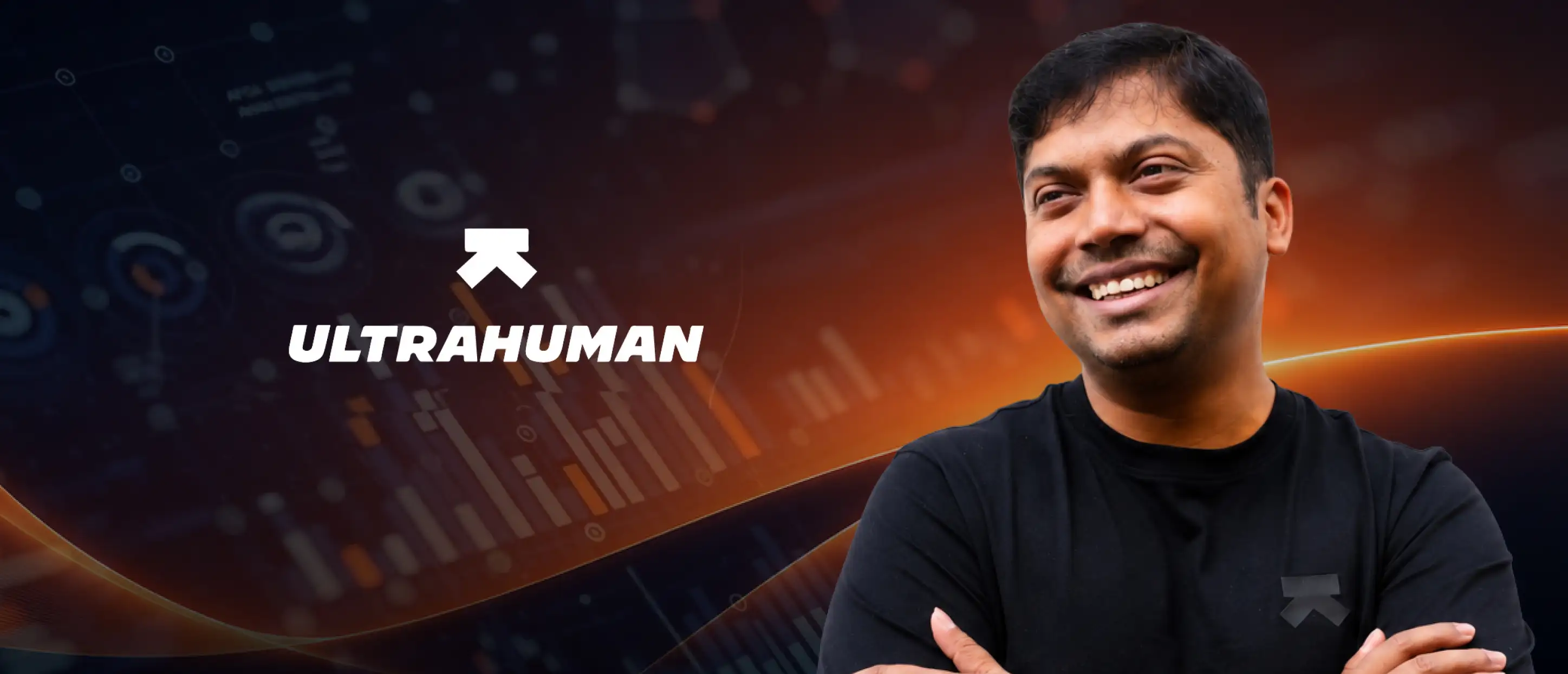
Exclusive | "The Future of Healthcare Is Continuous Health Intelligence": Ultrahuman CEO Mohit Kumar
Advertisement
The conversation around wearables is no longer limited to counting steps or tracking sleep. Increasingly, the focus is shifting towards continuous health intelligence that can detect risks early, influence behaviour, and ultimately prevent disease before it develops. At the forefront of this transformation is Ultrahuman, one of India's fastest-growing health technology companies, which is redefining the role of wearables by integrating continuous glucose monitoring (CGM), laboratory diagnostics, molecular biomarkers, and clinical-grade sensing into a unified health platform.
As the company expands its global footprint and advances its preventive healthcare vision, Ultrahuman is positioning itself not merely as a consumer wearable brand, but as a clinical-grade health data company with a long-term ambition to make preventive healthcare more accessible and scientifically driven. By combining multiple streams of physiological data, the company aims to generate medically actionable insights that encourage healthier behaviours and enable intervention long before disease manifests.
In an exclusive interaction with Digital Health News, Mohit Kumar, Founder & CEO, Ultrahuman, shares how the company is evolving beyond hardware, why continuous glucose monitoring could become a cornerstone of preventive healthcare, the importance of clinical validation in the wearable industry, and how India is uniquely positioned to contribute to the next wave of global health innovation.
Q1. Ultrahuman has evolved significantly over the past few years. How do you envision the future of continuous health intelligence, and what role will it play in shifting healthcare from reactive treatment to proactive intervention?
If you look at the journey of Ultrahuman, we've evolved from being a wearable-device company into what we believe is fundamentally a health data company. That's really how we see ourselves today.
The idea is to bring together different sources of health information—whether it's wearables, continuous glucose monitoring, laboratory blood tests, or molecular biomarkers—and aggregate all of that data into one platform. The purpose isn't simply to collect data. It's to use that information to influence human behaviour and help people make better decisions about their health.
For us, that's where preventive healthcare begins. Instead of waiting for diseases to develop and then treating them, we believe people should have access to continuous insights that allow them to understand what's happening inside their bodies much earlier. When people receive actionable information at the right time, they can make meaningful lifestyle changes that improve long-term health outcomes.
That's the roadmap we're building towards over the coming years. We believe continuous health intelligence will play a central role in moving healthcare away from being reactive and towards becoming truly preventive.
Q2. Continuous glucose monitoring is increasingly being discussed beyond diabetes care. Do you see CGM becoming as mainstream as fitness tracking? What barriers need to be overcome for mass adoption?
I absolutely think it has that potential.
The biggest challenge today is awareness. Most people don't realise that metabolic dysfunction begins much earlier than diabetes itself. In many cases, glucose dysfunction starts years before someone is formally diagnosed with diabetes, but people simply don't know that because they don't have visibility into what's happening inside their bodies.
That's where continuous glucose monitoring becomes extremely powerful. It gives people real-time feedback on how different foods, physical activity, sleep, stress, and everyday lifestyle choices affect their glucose responses.
One thing we've consistently observed is that when people actually see this data, behaviour changes happen very quickly. They begin making better food choices, improving their routines, and becoming much more conscious about their health because the feedback is immediate and highly personalised.
So while awareness is still relatively low today, I believe that as people start understanding CGM as a preventive health tool rather than just a diabetes management device, we'll see much broader adoption over time.
Q3. The wearable industry has become highly competitive. What differentiates Ultrahuman's long-term strategy, and how do you plan to build a sustainable business beyond hardware innovation?
Our differentiation has always been centred around clinical-grade accuracy and clinical acceptance.
We're not interested in building products that simply generate wellness metrics. We want to build products that create medically actionable data, data that people can trust and that ultimately becomes meaningful in clinical settings as well.
A good example is AFib detection in our smart ring. Features like these represent the direction we're taking as a company. They're not just consumer features; they're capabilities that are backed by clinical thinking and are designed to deliver real health value.
Over time, we believe products that are clinically validated and clinically accepted will create much stronger differentiation than hardware innovation alone.
At the same time, we continue to see the overall market as a very large opportunity because it's driven by genuine health needs. Lifestyle monitoring gives people an accessible way to improve their health before they require more invasive medical interventions, and we believe that's an area with enormous long-term potential.
Q4. As Ultrahuman continues its global expansion, what opportunities excite you the most over the next three to five years? How do you see India contributing to global health-tech innovation?
We're extremely excited about what lies ahead.
India has a unique combination of advantages. It has tremendous scale, relatively cost-efficient healthcare, and one of the world's largest patient populations. Together, these create an opportunity to generate structured disease data that can be incredibly valuable for preventive-health science.
We believe this kind of large-scale data can help drive discoveries that improve health outcomes, not only in India but globally. That's something we're deeply excited about because it allows us to apply practical science at scale to solve real health problems.
We feel that is extremely gratifying to us, and that's what we're really excited about.
If you look at our team, many of us actually come from engineering and science backgrounds. From an engineer's and scientist's perspective, this is a dream—to build something that millions of people use to actually improve their health and improve their lives.
That's ultimately what motivates us. It's not just about building technology or launching products. It's about creating science-driven health solutions that can have a meaningful impact on millions of people across the world.
Stay tuned for more such updates on Digital Health News