



Uttar Pradesh’s Healthcare GCC Playbook: Powering Global Health Innovation Through Infrastructure, Talent and Digital Transformation

With a target of more than 500 Global Capability Centres by 2030–31, Uttar Pradesh is positioning itself to attract high-value global operations. Its expanding connectivity, established technology hubs, medical education network, pharmaceutical research institutions, and dedicated GCC policy offer a potential foundation for healthcare and life sciences investment.
Lucknow is emerging as an important centre in Uttar Pradesh’s ambition to strengthen its position in India’s expanding Global Capability Centre (GCC) ecosystem. With growing infrastructure, improving connectivity, a strong educational network, and a developing technology landscape, the state is creating opportunities to attract global enterprises and support high-value business operations. For healthcare and life sciences, this offers a platform to bring together technology, research, specialised talent, and digital innovation.
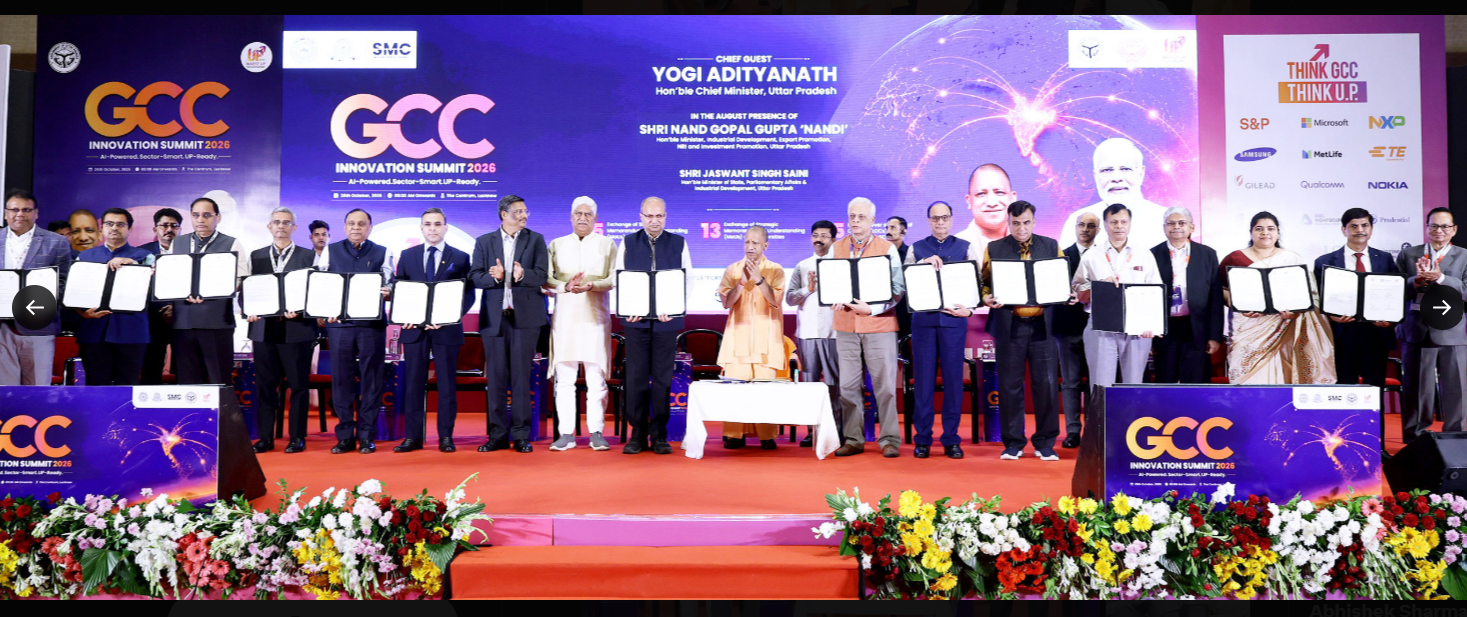
The Uttar Pradesh GCC Innovation Summit 2026, held in Lucknow on October 26 and 27, reflects this ambition. With a target of more than 500 GCCs by 2030–31, the state is positioning itself to attract global organisations, strengthen industry-academia collaboration and create new opportunities for skilled professionals. Lucknow’s technology ecosystem, alongside the state’s expressways, airport connectivity, medical institutions and proposed AI infrastructure, adds to its potential as a destination for healthcare-focused global operations.
Uttar Pradesh’s investment proposition spans a broad network of expressways, railways, airports, industrial corridors, IT parks, and Special Economic Zones (SEZs), along with growth centres such as Noida, Greater Noida, Lucknow, Kanpur, Agra, Varanasi, Prayagraj, and Gorakhpur. Investment material cites 22 expressways, 22 airports, more than 16,000 km of railway network, 40+ IT parks and 25 SEZs, reflecting the scale of infrastructure being developed to support investment and connectivity.
Healthcare GCCs could play a significant role in this journey, supporting areas such as health information technology, artificial intelligence, clinical research, pharmaceutical services, medical devices, data analytics and digital health operations. Backed by the Uttar Pradesh GCC Policy 2024 and the state’s broader investment initiatives, the emerging ecosystem presents an opportunity to connect global healthcare expertise with India’s growing digital health capabilities.
In posts on X, Chief Minister Yogi Adityanath said: “Under the able guidance of Hon'ble Prime Minister Shri Narendra Modi Ji, the resolve of the double-engine government is to ensure that the benefits of development reach the last person in society and that the youth of Uttar Pradesh get the opportunity to establish a global identity on their own soil. Under the leadership of Prime Minister Narendra Modi, while India has emerged as the 'GCC Capital of the World', Uttar Pradesh is now becoming a hub of India's electronics ecosystem.”
1. The GCC ambition: From investment interest to execution
Chief Minister Yogi Adityanath has set a target of establishing more than 500 GCCs in Uttar Pradesh by 2030-31. The UP GCC Innovation Summit 2026 is organised by the IIT Kanpur Alumni Association in collaboration with Invest UP and HCLTech. Its agenda includes AI-led transformation, investment decisions, product ownership, innovation, talent development and the changing role of global business services.
The summit’s announcements offer a practical view of the state’s approach. Fifteen industry MoUs were signed, five Letters of Comfort were issued to prospective investors, and MoUs were exchanged with 13 academic institutions. These announcements are intended to support investment, skill development and industry–academia collaboration. They represent steps towards project development, however, and should not be treated as proof that every proposed investment is already operational.
The five Letters of Comfort were issued to Havells India Limited, Ameriprise India LLP, MetLife Global Operations Support Centre Private Limited, LG Soft India Private Limited and WSP Consultants India Private Limited. The WSP letter remains subject to approval by the state’s Industry Minister and issuance of the formal letter.
The industry MoUs cover GCC expansion, technology-led investment and talent development. Partners named in the summit announcements include EY GDS, AML RightSource, Computacenter, MetLife, DSV, DAMAC, Altruist and Smartworks. Smartworks plans to establish two dedicated campuses in Lucknow. Training and skill-development collaborations involve Paytm, AWS, Barclays, IBM and Naukri; Paytm signed two MoUs as part of these collaborations.
The state also exchanged MoUs with 13 academic institutions: IIT Kanpur, IIT Roorkee, IIM Lucknow, IIT (BHU) Varanasi, Aligarh Muslim University, Shiv Nadar University, MNNIT Allahabad, Lucknow University, IIIT Allahabad, IIIT Lucknow, Deen Dayal Upadhyaya Gorakhpur University, Amity University and Dr A.P.J. Abdul Kalam Technical University.
The next measure of progress will be the conversion of announcements into operating centres, sustained hiring, industry-linked training and higher-value work in engineering, research, analytics and product development.
2. Uttar Pradesh’s infrastructure, talent, and innovation advantage
Uttar Pradesh is India’s third-largest state economy, with a population exceeding 25 crore. Invest UP reports that the state contributes 9.1% of India’s GDP. Its scale, connectivity and talent base form the broader foundation for attracting global investment.
Infrastructure built for GCC scale
State investment material cites 22 expressways, 22 airports and more than 16,000 km of railway network. It also lists 40+ IT parks and 25 Special Economic Zones (SEZs). Summit material further cites five international airports and an industrial land bank exceeding 75,000 acres. These broad investment figures may use a wider scope than operational-only government counts, so infrastructure totals should be read with their definitions and reporting dates.
The distinction between the headline investment inventory and operational infrastructure is important. The state’s 2026–27 Budget material separately reports 7 operational expressways, 15 under construction, 16 operational airports and metro connectivity across six cities. The summit’s infrastructure pitch also refers to five international airports. These counts are not directly interchangeable: one may cover airports and airstrips or projects at different stages, while another may count only operational facilities. Similarly, references to an extensive expressway network should not be converted into a percentage of national coverage unless the underlying measure-route count or total kilometres, operational or planned—is stated.
The wider transport proposition includes rail connectivity, metro systems, the Namo Bharat network and inland waterways. The investment material cites more than 16,000 km of railway network; other official summaries may use different measures, such as track length or route kilometres. Uttar Pradesh also has access to National Waterway 1 through Varanasi and Prayagraj. For GCCs, this connectivity can help with staff mobility, business travel and links between office locations, industrial clusters and logistics infrastructure, although the practical advantage depends on the location of each project and the services available there.
Key road links include the Yamuna, Agra–Lucknow, Purvanchal and Bundelkhand expressways. Noida International Airport, expanding metro connectivity and the Namo Bharat network are part of the state’s next-generation connectivity plans. The state’s multi-city growth platform includes Noida, Greater Noida, Lucknow, Kanpur, Agra, Varanasi, Prayagraj and Gorakhpur. The State AI Mission, deep-tech hubs, a proposed AI City in Lucknow and a robotics cluster are intended to attract AI-led GCCs, product engineering teams, R&D facilities and advanced business services.
Summit information also cited Uttar Pradesh as accounting for 55% of India’s mobile manufacturing and 60% of its electronic components. These are state-reported figures and should be attributed to the relevant official material if used in external communications. Noida and Greater Noida remain established corporate hubs, while Lucknow, Kanpur, Agra, Varanasi, Prayagraj and Gorakhpur offer opportunities to widen the state’s investment footprint.
Technology, engineering and management talent
Invest UP lists more than 8,375 colleges and 82 universities, along with 3,005+ ITIs/ITCs and 1,416 polytechnics. It ranks the state second nationally in management colleges and fourth in engineering colleges. Summit information cites an estimated 6.7 lakh professionals, including three lakh technology and engineering professionals, and more than two lakh STEM graduates annually. These figures indicate the scale of the talent pool, not the number of candidates immediately available for specialised GCC roles.
Leading institutions include IIT Kanpur, IIT (BHU) Varanasi, IIIT Allahabad, IIIT Lucknow, MNNIT Prayagraj, Dr A.P.J. Abdul Kalam Technical University in Lucknow and Harcourt Butler Technical University in Kanpur. IIM Lucknow adds management expertise to the ecosystem.
This combination can support GCC functions across software engineering, AI, data analytics, cybersecurity, product development, business operations and research. The opportunity will depend on how effectively employers connect with institutions and convert the available talent pool into specialised, industry-ready capabilities.
3. Healthcare and life sciences: A specialised GCC opportunity
Healthcare technology combines software, clinical practice, scientific research, regulation and patient safety. Healthcare GCCs can support hospitals, health insurers, pharmaceutical companies, diagnostics providers, medical technology manufacturers and digital health businesses. Their work can extend beyond general IT and back-office services to product engineering, data platforms, clinical research technology and global healthcare operations.
Potential investment areas include:
- Digital health: Electronic health records (EHRs), telemedicine, patient engagement and hospital information systems.
- Healthcare analytics: Claims, population health, operational reporting and data quality.
- AI in healthcare: Automation, clinical documentation, imaging workflows and carefully evaluated AI applications.
- Pharma and biotechnology: Clinical data management, research analytics, pharmacovigilance technology and regulatory systems.
- Medical technology: Connected devices, diagnostics, medical software and product lifecycle support.
- Cybersecurity and compliance: Privacy engineering, access management, security monitoring and secure data exchange.
- Global enterprise services: Finance, procurement, HR and other business functions for international healthcare organisations.
These are potential areas for investment, not a claim that all these activities are already established in the state. Their development will require specialised talent, reliable infrastructure, partnerships and compliance with applicable regulatory and quality requirements.
4. Digital health infrastructure: Scale and safeguards
Uttar Pradesh’s participation in the Ayushman Bharat Digital Mission (ABDM) is one part of its healthcare technology proposition. The state dashboard figures supplied for this article report:
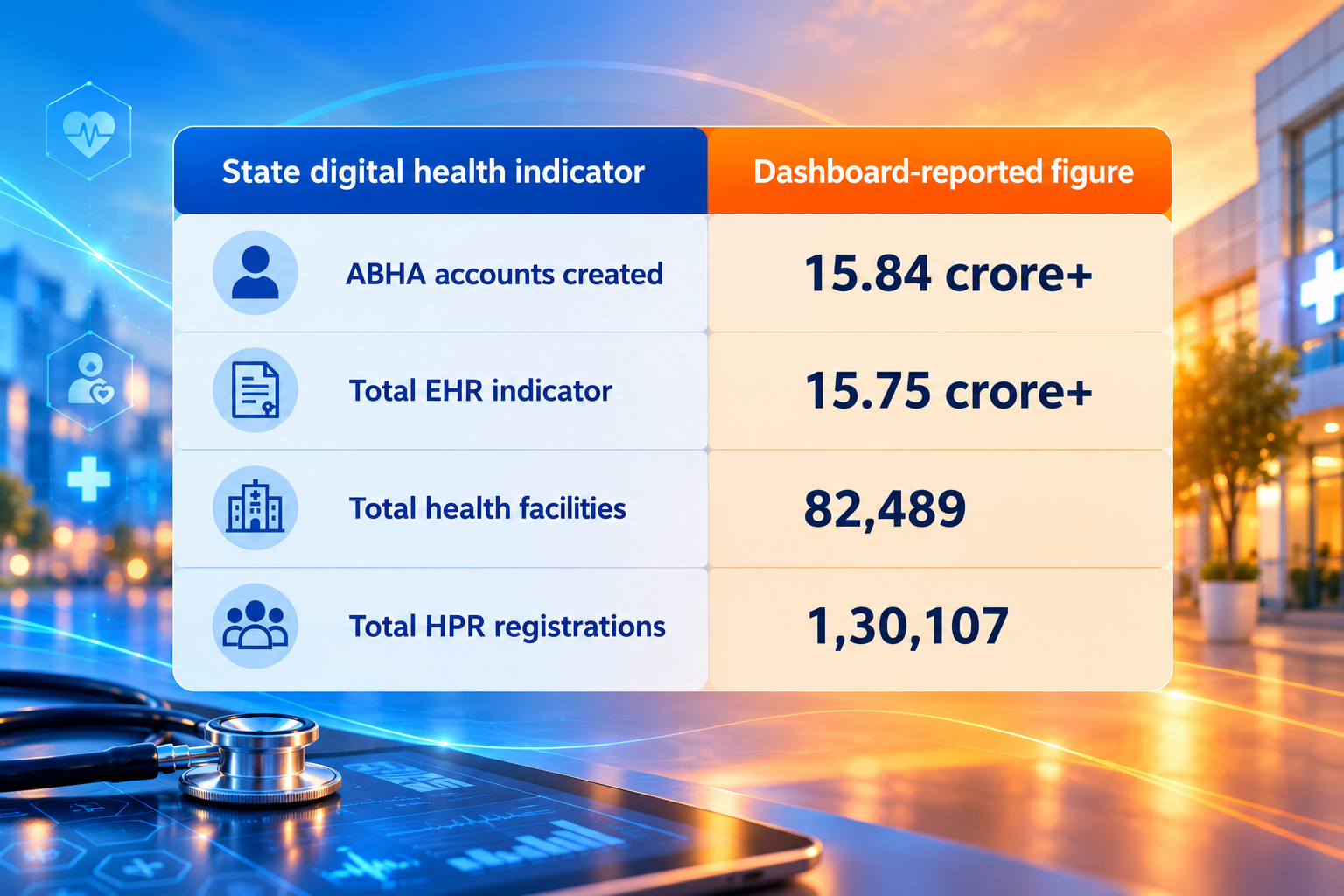
The 100% HFR coverage figure should be confirmed against the latest official dashboard definition and reporting date before publication.
These indicators are not interchangeable. An ABHA is a digital health identifier, not a complete medical record. The dashboard’s “Total EHR” indicator should not automatically be interpreted as the number of unique patients with complete medical histories or as proof that all participating systems are interoperable.
ABDM aims to support a connected digital health ecosystem through building blocks that include ABHA, the Health Facility Registry (HFR), the Healthcare Professionals Registry (HPR) and mechanisms for health information exchange. For GCCs, this can create demand for systems integration, secure APIs, consent and identity workflows, data quality, interoperability testing and cybersecurity.
However, ABDM participation does not give commercial organisations automatic access to patient records. Any use of personal health information must follow applicable law, authorisation, relevant consent requirements and appropriate safeguards. Synthetic or properly de-identified datasets may be more suitable for many software testing and development activities.
National digital health initiatives, including work on healthcare AI, data standards and terminology, also form part of the wider environment. National figures must not be attributed to Uttar Pradesh, and national programme milestones do not by themselves prove that every state facility is digitally mature or fully interoperable.
5. Medical education and research assets
The state’s 2026–27 Budget reports 81 medical colleges: 45 government and 36 private. Invest UP separately lists 208 medical, biotechnology, and pharmacy colleges and 18 pharmaceutical research institutions. These are different categories and should not be combined into a single medical-college total.
Leading medical and research institutions include AIIMS Gorakhpur, AIIMS Rae Bareli, Sanjay Gandhi Postgraduate Institute of Medical Sciences (SGPGI), King George’s Medical University (KGMU) and the Institute of Medical Sciences at Banaras Hindu University. The research ecosystem includes the Central Drug Research Institute (CDRI), National Botanical Research Institute (NBRI), Indian Institute of Toxicology Research (IITR) and National Institute of Biologicals (NIB).
These institutions could help support training, research partnerships and specialised roles in clinical informatics, healthcare data management, biostatistics, medical software quality assurance, regulatory operations and health AI evaluation. Such partnerships need to be built through clear agreements, appropriate governance and measurable training or research outcomes; institutional presence alone does not guarantee an available GCC talent pipeline.
6. Beyond Noida: A multi-city investment platform
Noida and Greater Noida offer an established technology and corporate base within the National Capital Region. Uttar Pradesh’s broader strategy is to expand opportunities across Lucknow, Kanpur, Agra, Varanasi, Prayagraj and Gorakhpur, using different combinations of talent, institutions, connectivity and industrial infrastructure.
Noida and Greater Noida
The NCR ecosystem can support recruitment, enterprise technology, cybersecurity, analytics and global business operations. Existing technology and industrial activity may also be relevant to connected devices, diagnostics and medical technology. For investors, the opportunity should be assessed through the actual scope of local operations, available skills, infrastructure and costs—not office presence alone.
Lucknow
Lucknow combines the state capital’s proximity to government with medical, academic and research institutions. HCLTech’s established IT City campus and announced Phase 2 expansion, reported at approximately INR 500 crore, are examples of the city’s technology-sector development. The proposed AI City at Vrindavan Yojana IT City is intended to support AI, deep-tech, compute, testing and innovation. It remains important to distinguish proposed facilities and received proposals from infrastructure that is fully operational.
Other emerging hubs
Kanpur, Agra, Varanasi, Prayagraj and Gorakhpur could complement the established NCR base by connecting employers with regional universities, engineering colleges, medical institutions and transport links. Their success in attracting high-value GCCs will depend on the availability of specialised professionals, reliable utilities and connectivity, suitable workspaces, local partnerships and execution of planned infrastructure.
7. The Uttar Pradesh GCC Policy 2024: Incentives, eligibility and investor support
The Uttar Pradesh GCC Policy 2024 is a central part of the state’s attempt to attract global operations and encourage centres to undertake higher-value work. The policy is designed to support eligible GCCs across establishment, operations, talent development, research and development, and expansion. It distinguishes between Level-1 and Advanced GCCs, with eligibility linked to minimum investment or employment and with different thresholds for Gautam Buddha Nagar and Ghaziabad.
Eligibility thresholds
According to Invest UP’s published policy summary, the principal thresholds are:
GCC category | Minimum investment or employment threshold |
Level-1 GCC | At least INR 15 crore in most districts or INR 20 crore in Gautam Buddha Nagar and Ghaziabad; alternatively, at least 100 employees in other districts or 200 in Gautam Buddha Nagar and Ghaziabad |
Advanced GCC | At least INR 50 crore in most districts or INR 75 crore in Gautam Buddha Nagar and Ghaziabad; alternatively, at least 300 employees in other districts or 500 in Gautam Buddha Nagar and Ghaziabad |
The applicable definitions, documentation, implementation guidelines and other conditions determine whether a project qualifies. These thresholds should not be interpreted as automatic approval or a guarantee that a centre will receive every incentive. Prospective investors should confirm the current policy text and implementation rules before making financial decisions.
Key financial support
The policy summary sets out several categories of assistance for eligible projects:
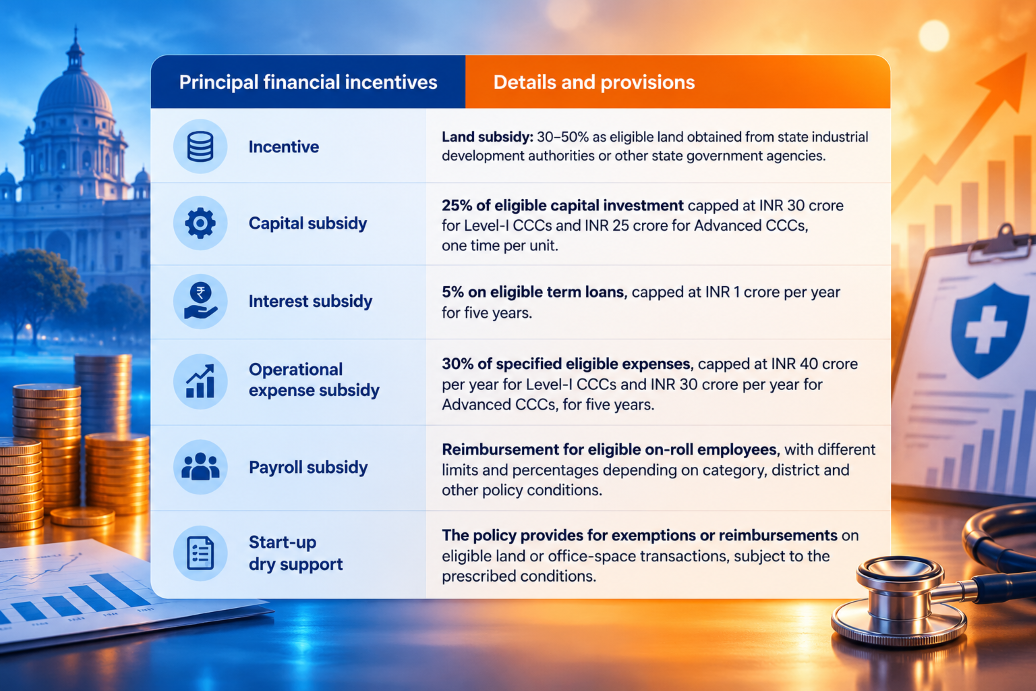
The policy summary also provides for payroll support over three years, with annual caps of up to INR 10 crore for Level-1 units and INR 20 crore for Advanced GCCs. The applicable reimbursement percentage and salary-related limits can vary by category, district and year of operation. Investors should verify all caps, exclusions, eligible employee definitions and application deadlines in the current policy documentation.
Operational expense support covers specified eligible costs, which may include lease rentals, bandwidth, power and data-centre or cloud services. Such support is conditional: the service provider, rental limits, type of expense and other requirements may affect eligibility. The availability of a stated subsidy does not mean every operating cost can be claimed.
Other provisions relate to skill development and research or innovation under the applicable arrangements. These are relevant to healthcare GCCs because centres may need to invest in specialised training, clinical informatics, medical software quality, AI evaluation, regulatory operations and research partnerships. However, a project’s actual eligibility and the value of any benefit depend on its structure and compliance with the policy.
From incentives to execution
For healthcare and life sciences companies, policy support can improve the economics of establishing a centre, particularly where the project requires substantial initial investment, specialised recruitment, technology infrastructure or ongoing data and cloud services. Yet incentives are only one part of the location decision. Investors must also assess talent availability, business continuity, reliable power and connectivity, office or laboratory requirements, cybersecurity, privacy obligations and access to appropriate research or clinical partners.
The state’s investor-facilitation architecture is intended to help companies navigate the process:
- Invest UP: The state’s nodal agency for investment promotion and GCC facilitation.
- Nivesh Mitra: A single-window platform for approvals and clearances.
- Nivesh Sarathi: Investor handholding, project facilitation and monitoring.
- Uttar Pradesh GCC Policy 2024: Incentives for eligible establishment, operations, talent, R&D and expansion.
- Data Centre Policy 2026: A framework aimed at supporting data-centre, AI-ready and high-performance computing infrastructure; specific benefits and implementation status should be checked against the notified policy.
- Proposed AI City, Lucknow: A planned ecosystem for AI, deep tech, computing, testing and innovation.
These mechanisms matter because the investor experience depends not only on the announcement of incentives but also on clear eligibility criteria, predictable approvals, coordination between departments and transparent project tracking. For healthcare GCCs, timely implementation is especially important when projects involve regulated workflows, sensitive data, specialised facilities or collaboration with hospitals and research institutions.
The policy’s long-term value should be measured through projects that reach operation, skilled jobs created, local supplier and research partnerships, employee training and the complexity of work performed in the state. A centre focused only on routine support may generate employment, but centres that develop products, engineering capabilities, analytics and research systems can build a deeper technology base. The state’s challenge is to convert policy interest into sustained, higher-value capability.
Source: Invest UP’s official GCC Policy 2024 and implementation information. All incentives remain subject to the policy text, applicable eligibility criteria, caps, exclusions, approvals and implementation rules.
8. AI, data governance and responsible healthcare innovation
AI offers potential applications in administrative automation, clinical documentation, medical imaging workflows, operational forecasting and research analytics. Healthcare use cases need careful evaluation because model performance can vary across populations, institutions and clinical settings. Appropriate validation, human oversight, security and ongoing monitoring are essential, especially where patient care may be affected.
The proposed Lucknow AI City could contribute to this ecosystem if the planned infrastructure, computing resources, partnerships and specialised workforce are delivered. Its value for healthcare GCCs will depend on demonstrable capabilities rather than the announcement of an innovation district alone.
The Digital Personal Data Protection Act, 2023, and the Digital Personal Data Protection Rules, 2025, form part of India’s evolving personal-data protection framework. Their commencement is phased, so organisations should verify the provisions in force at the time of a project. Healthcare GCCs must consider lawful data access, consent where applicable, security, retention, authorisation and contractual responsibilities. International organisations may also need to comply with requirements in other jurisdictions.
The opportunity for Uttar Pradesh is not simply to attract businesses using AI. It is to build the talent, governance and technical capabilities needed to develop and operate healthcare technology responsibly.
9. From summit announcements to measurable outcomes
The summit’s seven thematic sessions examined investment decisions, AI-first GCCs, the transition from service delivery to product ownership, start-up and centre-of-excellence partnerships, university skills for the AI era, and workforce reskilling. The main summit programme began yesterday, Monday, October 26, and the two-day event concludes today, Tuesday, October 27. These themes reflect a wider shift in the GCC model: global centres are increasingly expected to contribute to innovation, engineering and product development rather than only routine support.
Company representatives also shared examples of technology-sector investment and expansion in Uttar Pradesh. LG Electronics representative Brijesh Sharma said the company was investing INR 634 crore in its Eco Solutions GCC, with operations targeted by the end of 2026 and more than 500 high-value jobs planned. The centre is expected to focus on HVAC, heat pump technology and advanced product development, with further R&D in AI-based data-centre cooling technologies.
Smartworks representative Harsh Binani described the company’s office footprint in Noida and its expansion into Lucknow, including a reported 200,000-square-foot GCC hub at BBD Times Square. Microsoft India Development Center representative Rajiv Kumar highlighted talent, employee safety, infrastructure and policy support, and described the growth of Microsoft’s Noida centre. HCLTech representative Kiran Cherukuri referred to the company’s Lucknow campus, which he said employs about 1,500 people, and an AI-powered GCC Centre of Excellence developed with AWS.
These examples illustrate different parts of the state’s technology proposition. Company statements and announced plans should be attributed to the relevant representatives, and planned investments or job numbers should not be presented as completed outcomes until confirmed.
During the summit, the Chief Minister released a white paper titled The True Economics of AI Adoption in GCCs, prepared under the deep-tech innovation collaboration between HCL and IIT Kanpur. The summit also highlighted the role of industry–academia partnerships in preparing students for AI, analytics, product engineering and global business services.
Conclusion: Turning scale into global capability
Uttar Pradesh’s GCC proposition brings together a large economy, expanding transport links, established corporate hubs, a multi-city investment strategy, technology and medical institutions, digital health participation and a dedicated policy framework. Its ambition to establish more than 500 GCCs by 2030–31 is supported by the summit’s industry MoUs, investor Letters of Comfort and academic partnerships.
For healthcare and life sciences, the potential extends across digital health, clinical and pharmaceutical research technology, analytics, AI, medical devices, cybersecurity and global enterprise operations. The state’s ABDM indicators and medical education ecosystem provide relevant building blocks, but they should not be mistaken for proof of universal interoperability or a ready-made healthcare GCC cluster.
The next test is execution: converting investor interest into operational centres, building specialised talent, delivering planned infrastructure, creating high-value jobs and establishing trusted research and technology partnerships. The long-term measure of success will be whether Uttar Pradesh can turn its scale and connectivity into sustained global capability and responsible healthcare innovation.
Disclaimer: Figures are based on publicly available official sources and summit information available as of 27 October 2026. Data may vary by reporting period and definition. Infrastructure totals may include projects at different stages; announced investments, MoUs, Letters of Comfort and proposed developments are not necessarily completed or operational. Policy incentives remain subject to eligibility and applicable rules.
Stay tuned for more such updates on Digital Health News
Follow us