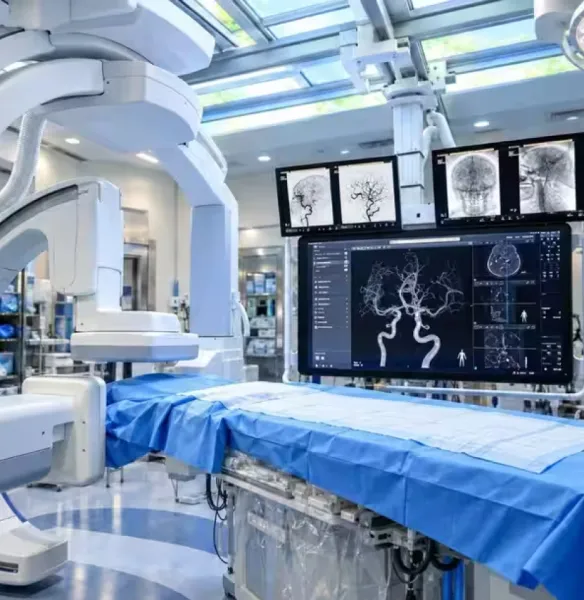




Google, NASA Develop AI-Powered Robot to Support Astronaut Healthcare on Mars Missions
Google and NASA are also exploring AI-based navigation and object-handling capabilities using an open-source Pi0 model developed by Physical Intelligence and running on Google Cloud infrastructure.
Google and NASA have been developing an AI-powered robotic assistant to support astronauts with medical needs and routine operations during future deep-space missions.
The robot is designed to retrieve medical equipment, assist with basic health monitoring, and manage logistical tasks, particularly when communication delays make immediate medical guidance from Earth difficult.
The initiative builds on the Crew Medical Officer Digital Assistant (CMO-DA), an AI-powered clinical decision support system that Google and NASA began evaluating in 2025.
According to Google Public Sector Vice President Jim Kelly, communication between Earth and a spacecraft travelling to Mars could involve round-trip delays of up to 44 minutes, making real-time medical guidance difficult during emergencies.
"An astronaut on a future deep space mission to Mars could face severe operational challenges, including round-trip communication latencies of up to 44 minutes," said Kelly.
To address these challenges, Google Public Sector is working with NASA's Human Research Program, Johnson Space Center's Robotics Team and the Jet Propulsion Laboratory (JPL) to develop a physical robotic system.
The project is intended to support astronauts during missions under NASA's Artemis programme, which aims to expand lunar exploration and establish the foundation for future crewed Mars missions.
The robot is being designed as a multipurpose assistant rather than exclusively as a medical machine. It could transport cargo, organize tools, secure spacecraft compartments, and manage equipment when not required for healthcare-related activities.
For instance, if an astronaut experiences severe back pain that could indicate kidney stones, the robot could retrieve and prepare an ultrasound machine. The onboard crew medical officer would then examine the images and determine the appropriate medical response.
Google and NASA are also exploring AI-based navigation and object-handling capabilities to help the robot operate safely in confined spacecraft environments.
JPL is adapting spatial-awareness technologies developed for satellite operations, while Google DeepMind's MuJoCo physics simulator tests robotic movements before deployment on physical hardware.
In an early laboratory demonstration at Johnson Space Center's iMETRO facility, the robot achieved an initial 85% success rate in locating and moving a medical bag.
The system used an open-source Pi0 model developed by Physical Intelligence, running on Google Cloud infrastructure, alongside an eye-to-hand camera configuration to improve spatial awareness.
Google has tested approximately 15 edge-computing devices to identify hardware capable of running the AI models locally with limited power and computing resources.
The initiative remains at the proof-of-concept stage, and the reported laboratory results do not establish readiness for autonomous medical procedures. Google envisions a system that astronauts can operate through simple voice instructions while retaining direct human supervision.
"The ultimate goal is to build a robotic system that can execute a variety of tasks via simple voice instructions, under the astronauts' direct supervision and command," Kelly said.
The proposed system could eventually assist with routine health monitoring, including capturing basic vital signs and performing simple ultrasound-related tasks under the guidance of a human crew medical officer.
Stay tuned for more such updates on Digital Health News
Follow us