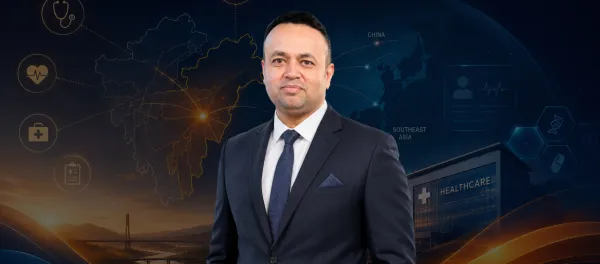
From Records to Intelligence: The Evolving Role of EHR/EMR in Data-Driven & AI-Enabled Healthcare

Advertisement
Authored by Nanda Kishore, CIO-IT, Continental Hospitals
As technology continues to evolve, healthcare is undergoing a major transformation driven by digital innovation and data-centric care models. One of the most significant shifts in recent decades is the movement toward fully digital patient records.
In this evolving landscape, Electronic Health Records (EHR) and Electronic Medical Records (EMR) systems are no longer limited to storing patient information; they are becoming strategic digital platforms that support interoperability, analytics, clinical decision-making, and AI-enabled care delivery.
Traditionally, EHR/EMR systems were perceived as digital repositories for patient records. However, their role has significantly evolved. Today, they serve as the backbone for clinical workflows, interoperability, analytics, and increasingly, intelligent decision-making. The transition from data capture to data intelligence is what defines the next phase of digital healthcare.
Interoperability: Enabling Continuity of Care
A critical enabler in this journey is interoperability. Leveraging global standards such as HL7 and FHIR, modern EHR systems facilitate seamless exchange of patient information across departments, diagnostic platforms, and external healthcare networks. This ensures continuity of care across the patient journey from outpatient consultations to inpatient admissions and post-discharge follow-ups while minimizing redundancy and improving patient safety.
At Continental Hospitals, our EMR rollout was designed not just as a system implementation but as a clinical transformation initiative. We focused on structured clinical documentation, standardized templates, and integrated workflows across specialities.
This has enabled clinicians to access longitudinal patient records in real time, improving both diagnostic accuracy and treatment outcomes.
CDSS Enhancing Patient Safety
One of the most impactful advancements has been the integration of Clinical Decision Support Systems (CDSS) within the EMR. By embedding evidence-based protocols and real-time alerts into clinician workflows, we can enhance patient safety and clinical efficiency. Alerts for drug interactions, allergy checks, and abnormal lab values act as critical safeguards, reducing the risk of medical errors. These systems are further strengthened by AI-driven models that provide contextual insights based on patient history and population-level data.
The integration of CDSS within EMR environments is gradually transforming healthcare delivery from intuition-based decision-making to evidence-driven clinical practice.
AI & ML Transforming Data
Artificial Intelligence is now playing a transformative role in how EHR/EMR data is utilized. Through technologies such as Machine Learning and Natural Language Processing, we are able to unlock value from both structured and unstructured clinical data.
At Continental Hospitals, we have initiated AI pilot projects in areas such as predictive risk stratification, early warning systems, and clinical documentation enhancement. These pilots aim to move healthcare delivery from a reactive model to a predictive and preventive one.
For example, predictive analytics models can identify patients at risk of deterioration based on real-time clinical parameters, enabling early intervention. Similarly, NLP-driven tools can extract meaningful insights from clinician notes, improving documentation quality and enabling secondary use of data for analytics and research.
The Future of Clinical Research
Another key dimension of EHR evolution is its role in clinical research and real-world evidence generation. High-quality, longitudinal data captured through EMR systems provides a strong foundation for observational studies, cohort analysis, and clinical trials. By aligning with standardized data models, healthcare institutions can participate in global research initiatives and contribute to evidence-based medicine.
At Continental Hospitals, we see EMR not just as an operational tool but as a strategic asset for advancing clinical research.
Governance & Data Security: The Foundation of Success
Despite rapid technological advancements, the success of any EHR/EMR initiative depends on strong governance and user adoption. Driving clinician engagement requires intuitive system design, minimal disruption to workflows, and continuous training. Equally important are data governance frameworks that ensure data quality, privacy, and security while enabling accessibility for care delivery and research.
As healthcare systems become increasingly interconnected and data-intensive, governance will remain central to ensuring sustainable digital transformation.
Wrapping Up
Looking ahead, the future of EHR/EMR lies in becoming an intelligent, interoperable clinical platform. The convergence of AI, connected medical devices, and patient-generated health data will further enhance the richness and utility of clinical data. Integration with telemedicine and remote monitoring solutions will support continuous care models, particularly for chronic disease management.
In conclusion, the evolution of EHR/EMR systems is redefining healthcare delivery by improved care coordination and data-driven clinical decision-making.
At Continental Hospitals, digital transformation has not been an afterthought; it has been a foundational principle from day one. From the very inception of operations, we adopted a fully integrated Electronic Health Records / EMR environment with a clear mandate: there would be no parallel paper-based processes and no exceptions for clinical or operational staff. This early commitment has enabled us to build a truly data-driven healthcare ecosystem.
Our early adoption of a fully digital ecosystem, combined with ongoing investments in AI and clinical decision support, positions us to deliver safer, smarter, and more personalized care.
The focus now is clear: transform EHRs from systems of record into systems of intelligence that drive better outcomes for patients and providers alike.
Disclaimer: This is an authored article, DHN is not liable for the claims made in the same.
Stay tuned for more such updates on Digital Health News