Sakra IKOC Performs India’s First AI-Powered Total Knee Replacement Using Surgical Robots
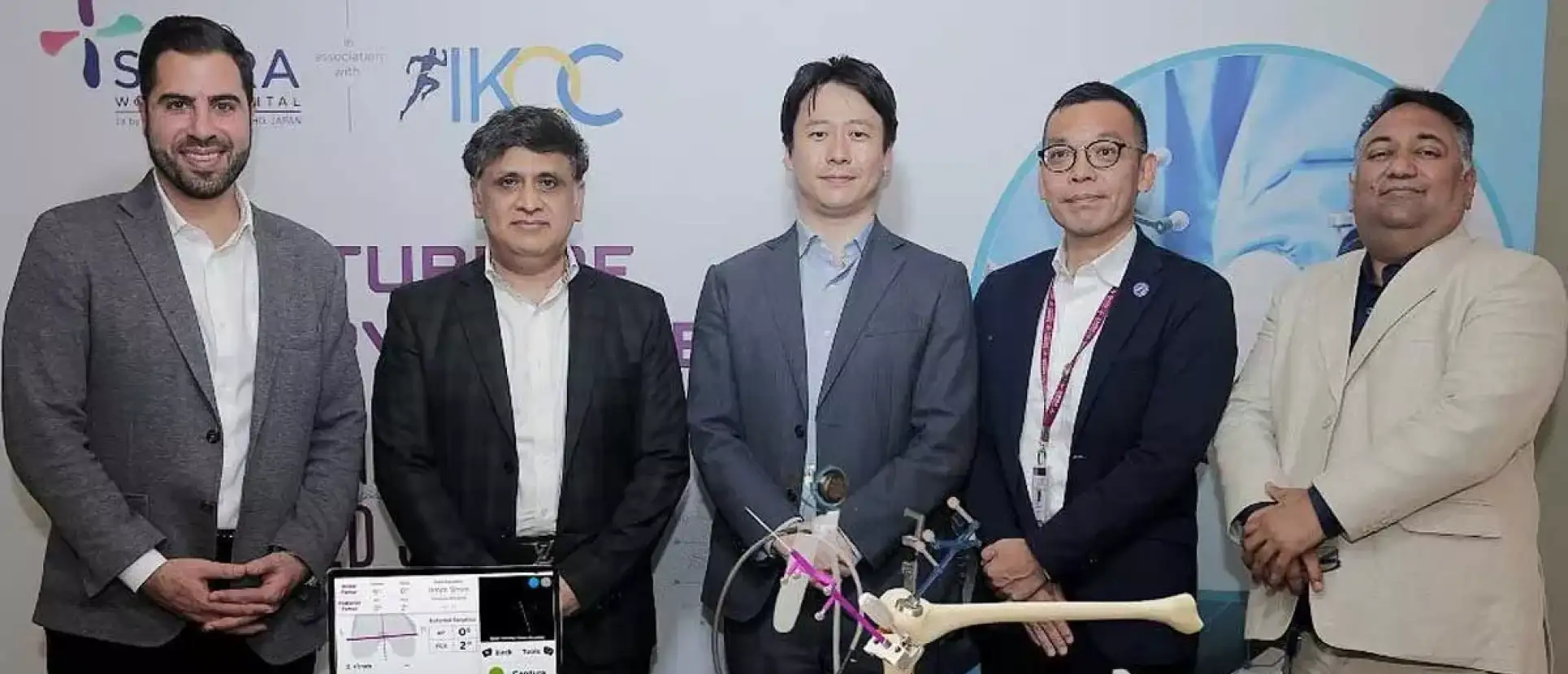
The Intellijoint KNEE system uses AI-powered navigation and intraoperative data to assist surgeons, enabling accurate implant alignment and joint balancing.
Sakra IKOC, a Bangalore-based multi-speciality hospital, has successfully performed India’s first AI-powered total knee replacement surgery, using the Intellijoint KNEE system to deliver real-time, intelligent guidance during the procedure.
Conducted on a 53-year-old female patient, the surgery signals the arrival of next-generation surgical robots that combine artificial intelligence with precision orthopaedics, without the complexity of conventional robotic systems.
The procedure has also marked the formal entry of Intellijoint Surgical, a Canadian medical technology company, into the Indian market.
Armen Bakirtzian, Co-Founder and CEO of Intellijoint Surgical Inc., said, “We are thrilled to mark Intellijoint Surgical Inc.’s first successful knee replacement in India, achieved in collaboration with Dr Chandrashekar P and his exceptional team at Sakra IKOC Multi-Speciality Hospital. Witnessing firsthand how our technology is transforming patient outcomes in India is truly inspiring.”
Unlike traditional robotic platforms that rely on bulky equipment and pre-operative CT scans, the Intellijoint KNEE system uses AI-powered navigation and intraoperative data to assist surgeons during surgery.
The imageless and minimally invasive approach enables accurate implant alignment and joint balancing, while maintaining a streamlined surgical workflow.
Dr Chandrashekar P., Director of Orthopedics at Sakra IKOC Multi-Speciality Hospital, said, “The Intellijoint KNEE system offers real-time measurements during the surgery, ensuring bone cuts are precise with the implants strategically placed, to achieve optimal joint alignment. This fast and easy-to-use surgeon-controlled AI-based system is built for the convenience of orthopaedic surgeons, while enhancing patient recovery and providing better, predictable, long-term outcomes. We are indeed proud to bring this advancement to India.”
A key clinical advantage of the technology lies in how it adapts to the patient’s anatomy. The system registers anatomical landmarks, including the hip’s center of rotation, removing the need for intramedullary rods that are commonly used in knee replacement surgeries.
It is also pinless, meaning no additional incisions or external pins are required, reducing surgical trauma and the risk of complications. These features collectively support faster rehabilitation, improved joint function, and potentially longer implant life.
Stay tuned for more such updates on Digital Health News
Follow us