How AI is Quietly Transforming Radiology in Hospitals

How AI is Quietly Transforming Radiology in Hospitals
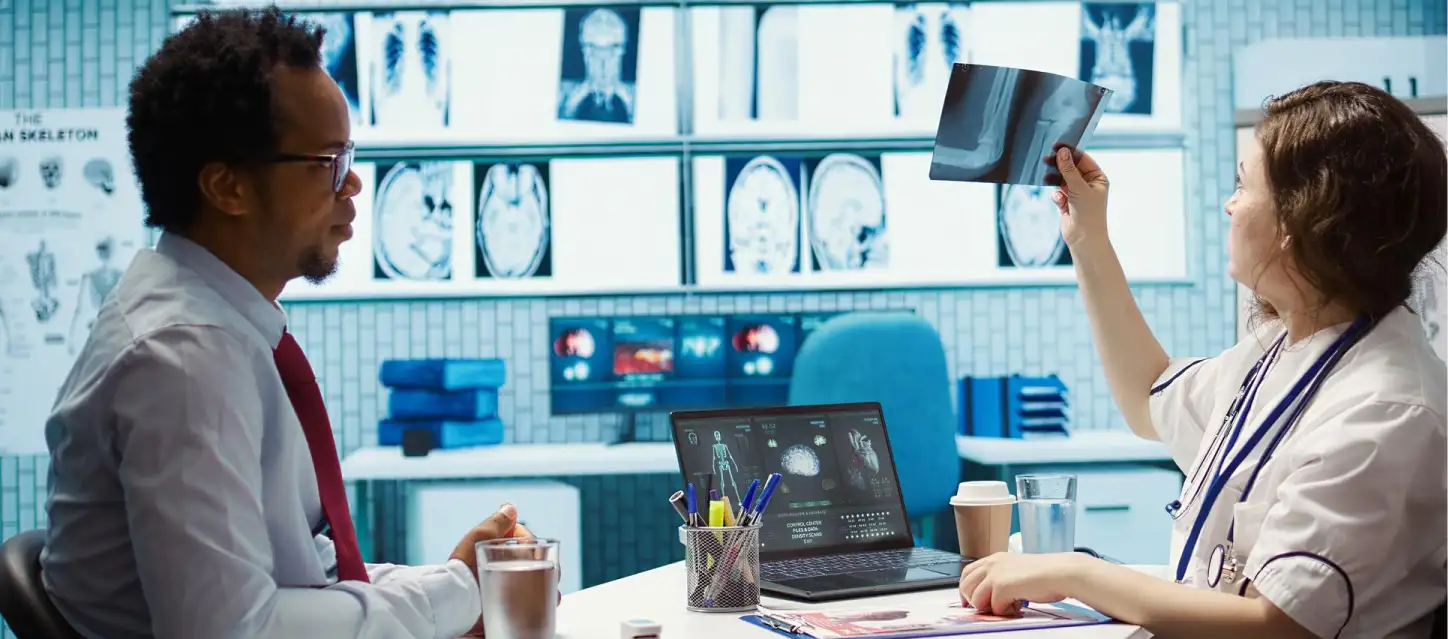
Federated learning is an early-stage approach hospitals are exploring to build AI that works reliably across different patient populations, allowing AI models to train across multiple hospital sites without patient data ever leaving each institution.

Every day, radiologists review hundreds of medical images, CT scans, MRIs, and X-rays, looking for signs of disease. It is detailed, demanding work, and the volume keeps growing. Artificial Intelligence has become one of the most significant shifts in hospital-based radiology over the past decade. What began as basic computer-aided detection in the 1990s, tools that flagged suspicious areas on mammograms with limited reliability, has evolved into sophisticated systems capable of analyzing thousands of images in seconds and identifying findings that a human eye might overlook after hours of reviewing scans.

Hospitals around the world have started embedding AI tools directly into their radiology workflows, and the results are reshaping how diagnoses are made, how quickly patients receive care, and how radiology departments manage an ever-growing volume of imaging data. The technology is no longer experimental. It is operational, and its reach across hospital systems is expanding fast. Here is what that shift looks like on the ground.

A Technology Whose Time Has Come

Today, the US Food and Drug Administration has cleared close to 900 AI tools for use in medical imaging, with radiology accounting for roughly 75 to 78 per cent of all AI medical device approvals. In Europe, over 220 commercial AI radiology products are now certified for use, up from around 100 just three years ago. These numbers reflect how quickly hospitals have moved from piloting AI to integrating it into everyday clinical workflows.

The conditions driving this shift are well established. Radiology departments across the world face growing imaging volumes, a shortage of trained specialists, and increasing pressure to deliver results faster. A single CT scan of the chest can contain over 600 individual images. Multiplied across dozens of cases a day, the cognitive load on radiologists is significant. AI tools help manage that load by directing attention where it matters most.

What AI Actually Does in a Hospital Setting

The most common use of AI in hospital radiology today involves image interpretation support. Algorithms scan incoming images, highlight areas of concern, and assign urgency scores to cases. A scan that shows signs of a stroke, for example, can be automatically flagged and moved to the top of the review queue, allowing a specialist to act before a patient deteriorates further. One well-documented example involves stroke detection. AI platforms used in over 1,600 hospitals have shown that automated stroke alerts can reduce the time from scan to treatment by over an hour on average, a difference that directly affects how much function a patient retains after a stroke.

In cancer screening, AI tools are helping detect tumors at earlier stages. Lung cancer detection algorithms have reached accuracy rates above 95 per cent in controlled studies. In breast cancer screening, AI has been shown to flag interval cancers, those missed between regular screenings, at rates approaching 50 per cent, reducing the chance that a growing tumor goes unnoticed. In populations screened at scale, they translate into earlier diagnoses and better outcomes.

AI is also being used for report generation. After reviewing an image, a radiologist can dictate observations and have AI instantly convert that into a structured clinical report, flagging inconsistencies, inserting findings in real time, and drafting a summary conclusion within seconds. What once took several minutes now happens almost immediately, freeing the radiologist to move to the next case.

The Role of Data Governance in Making AI Work

For all its promise, AI in hospital radiology runs on data, and the quality, structure, and governance of that data determine whether the technology performs as expected or becomes a liability. AI models are trained on large sets of medical images. If those images come predominantly from one type of scanner, one patient population, or one hospital system, the model may not perform as well when applied to a different setting. A tool trained largely on images from high-income institutions may underperform at a community hospital with older equipment or a more diverse patient mix. Studies have found that AI models deployed outside their original training environment can experience accuracy drops of up to 20 per cent.

This is where hospital data governance becomes critical. Hospitals need clear frameworks for how imaging data is collected, stored, labelled, and shared. Without standardized formats, consistent annotation practices, and robust privacy protections, the foundation on which AI models are built becomes unstable. Regulations such as HIPAA in the United States and GDPR in Europe set minimum requirements, but hospitals are increasingly moving toward more comprehensive internal governance structures, audit trails, oversight committees, and post-deployment monitoring systems that track how AI tools perform over time in real-world conditions.

Federated learning is one approach hospitals are exploring to address both data quality and privacy concerns at the same time. Rather than pooling patient images into a central database, this method allows AI models to be trained across multiple hospital sites without the data ever leaving each institution. It is an early-stage approach, but one that reflects how seriously the sector is taking the intersection of AI performance and patient data protection.

Radiologists are not Going Anywhere

One question that surfaces consistently in discussions about AI and radiology is whether the technology threatens the profession itself. The evidence so far suggests otherwise. AI tools reduce repetitive work, but they do not replace the clinical reasoning that radiologists bring to complex or ambiguous cases. When AI flags a finding, a trained specialist still determines what it means for a specific patient, considering their history, symptoms, and the broader clinical picture. Studies comparing AI-only reads with combined human-AI review consistently find that the combination outperforms either approach alone.

Surveys of radiologists in Europe found that 48 per cent were actively using AI tools in 2024, up from 20 per cent in 2018. The majority view AI as a tool that extends their capacity rather than replaces their judgment. What is changing is the nature of the work. Radiologists are spending less time on routine image triage and more time on interpretation, consultation, and oversight of AI outputs. That shift demands a new kind of training, one that includes understanding how AI models work, where they are likely to make errors, and how to read their outputs critically rather than accept them passively.

Looking Ahead

AI in hospital radiology is no longer a future prospect; it is a present reality in a growing number of institutions. The tools are becoming more capable, the regulatory frameworks more defined, and the clinical evidence more robust. But the hospitals that will get the most from this technology are those that treat data governance as a strategic foundation. Clean data, clear oversight, and well-trained clinicians who understand both the possibilities and the limits of AI; that combination is what will determine whether the technology delivers on its potential.

Stay tuned for more such updates on Digital Health News

Follow us

More Articles By This Author


Show All

Sign In / Sign up