IIT Bombay Develops Placenta-on-Chip, Advancing Foetal Research & Pregnancy Drug Safety

The platform can also replicate disease conditions such as gestational diabetes by exposing placental cells to elevated glucose levels, enabling researchers to observe how these conditions alter nutrient transport and barrier function.
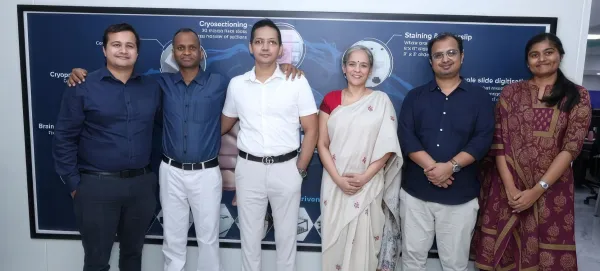
Scientists from IIT Bombay and the ICMR-National Institute for Research on Women's Health (ICMR-NIRWOH) have developed an indigenous placenta-on-chip platform that mimics the human placenta in a laboratory setting.
The device enables researchers to study how nutrients, hormones, medicines and waste products move between mother and foetus, offering a human-relevant model for pregnancy research and drug safety.
Published in the journal Biofabrication, the study describes a compact microfluidic device consisting of two chambers separated by a porous membrane.
Human placental cells and blood vessel cells are cultured on opposite sides, allowing the platform to reproduce several critical placental functions, including hormone secretion, nutrient transport, waste exchange and selective barrier activity.
The researchers have also designed the system to be simpler than many existing organ-on-chip technologies, making it easier to manufacture and adopt in research laboratories.
"Many organ-on-chip systems are powerful but often require specialised infrastructure. We wanted to develop a robust platform that could be adopted more broadly by research laboratories," said IIT Bombay's Prof Abhijit Majumder, co-corresponding author of the study.
The project was led by Dr Deepak Modi from ICMR-NIRWOH in collaboration with Prof Abhijit Majumder of IIT Bombay and maternal-foetal medicine specialist Dr Anshul Bhide.
According to the researchers, the platform can help scientists examine whether medicines cross the placental barrier, understand how they may affect the developing foetus and generate evidence that supports safer treatment decisions during pregnancy.
This is particularly important because pregnant women are often excluded from clinical drug trials, leaving limited data on medication safety.
The platform can also replicate disease conditions such as gestational diabetes by exposing placental cells to elevated glucose levels, enabling researchers to observe how these conditions alter nutrient transport and barrier function.
In the future, similar models may support investigations into pregnancy complications, including preeclampsia and foetal growth restriction, while accelerating the development of therapies designed specifically for maternal and foetal health.
Stay tuned for more such updates on Digital Health News
Follow us