Creating a Digital-First Hospital Without Losing the Human Touch

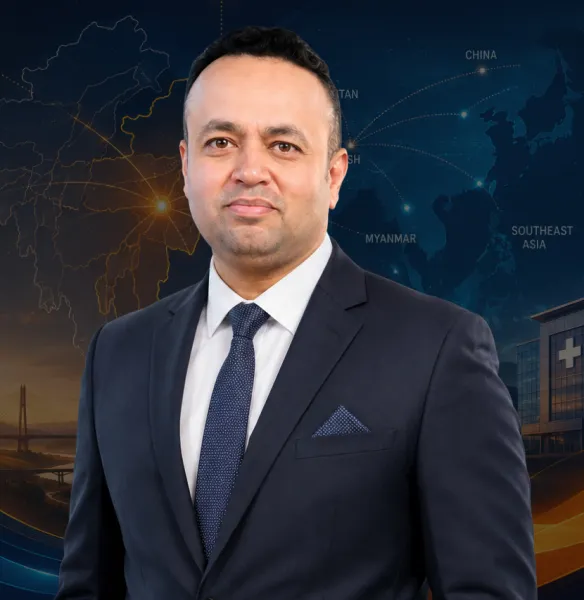
By - Dr Jijy Jacob, COO, Infant Jesus Hospital, Manimala, Kottayam, Kerala
The race towards digital healthcare is well underway. Across the world, hospitals are investing in electronic medical records, artificial intelligence, predictive analytics, virtual consultations and increasingly sophisticated hospital information systems. Governments are investing billions in national digital health missions, while boards are approving capital expenditure on technologies that promise better managerial and clinical outcomes. No one is nostalgic for the old times.
Digital technologies undoubtedly help address many challenges. Electronic medical records reduce duplication. Automation streamlines administrative work. Predictive analytics enables earlier intervention. These are significant advances, and healthcare would be poorer without them.
But healthcare has always been unlike any other industry. Efficiency matters, but it has never been the defining measure of success. However, we have let efficiency become the dominant language of digital transformation. Hospitals increasingly celebrate shorter turnaround times, faster documentation, and automated workflows. Even in sectors that have automated aggressively, such as banking, institutions have had to work hard to preserve customer trust precisely because automation strips away the reassurance of a human presence at the point of transaction. Hospitals face this challenge even more because every improvement in efficiency ultimately has to strengthen a human relationship: between a patient and a clinician, between families and caregivers, and so on.
This is not merely an impression. These are central to clinical care. A substantial body of clinical communication research links physician-patient trust and empathic communication to better adherence, lower anxiety, and improved self-reported recovery; the World Health Organisation's own patient-safety and person-centred care frameworks make the same point.
If trust is central to good medicine, then digital transformation has to be judged differently. That is why I have come to believe that the next phase of digital transformation demands a different outlook. The objective of this new phase should be to use digital capability to create more time, more attention and more presence for the patient.
My own experience, for example, has shown how easily hospitals can lose sight of this.
While leading the implementation of an electronic medical record and patient experience platform, I expected technology to be the principal challenge; in reality, changing professional behaviour proved far more difficult. I learned that you can buy the best software in the world, but you can’t purchase clinical ownership. The new digital workflows failed because doctors saw them as a corporate headache, not a clinical tool that helped everyone. They checked boxes to clear their screens and bypassed the rules to save time.
We eventually stopped measuring adoption purely by compliance with mandatory fields and started reviewing, with clinicians themselves, whether the record was actually improving handovers and reducing repeated questions to patients. Senior clinicians who had been early sceptics were brought in to co-design the workflow. Adoption has improved now because clinicians have begun to see it as their own tool. The same principle applies equally to nursing teams, who often bear the greatest documentation burden while remaining the professionals who spend the most time with patients. The lesson for me was uncomfortable. We had invested months selecting the software, yet far too little time preparing clinicians for the change it demanded.
Years ago, working in a different hospital, I encountered the opposite problem of this thing dominating the whole interaction. Here, digital adoption was exemplary: clinical documentation was meticulous, teams relied confidently on electronic records, and everything was digital. Yet I occasionally observed another unintended consequence. During consultations, clinicians were sometimes so absorbed in reviewing investigations, updating records and so on that the patient seemed to become the second focus of the encounter.
Here we introduced a simple discipline: a few minutes of screen-free conversation at the start and close of each consultation, with documentation completed either before the patient entered or after they left, wherever clinically possible. It was a modest change, but patient feedback on communication improved within a few months.
The contrast in the problems faced has remained with me ever since. Neither represented the destination that digital healthcare should aspire to reach. This whole mission succeeds when technology becomes almost invisible while allowing clinicians to devote their full attention to the person sitting in front of them.
The experience taught me that digital transformation is far less about software than it is about leadership. The systems that gained acceptance were those that clinicians helped shape, not those imposed upon them. Equally, documentation should support the consultation, not compete with it. Protecting time for uninterrupted interaction with patients is as important as designing efficient digital workflows.
This has important implications for hospital Boards. Digital transformation should not be reviewed solely through implementation milestones or capital expenditure. Governance must extend to questions that are harder to quantify but more meaningful: Has technology reduced clinicians' cognitive burden? Has communication improved? Has the patient's experience changed? These are not operational details; they are indicators of whether digital investment is achieving its intended purpose.
It also changed the way I think about success. Hospitals often celebrate implementation milestones, compliance rates and efficiency gains. These are necessary, but they are not sufficient. A digitally mature hospital should also ask whether communication has improved, whether clinicians are more engaged, and whether patients feel genuinely heard.
Technology should make care safer, more coordinated and more efficient. But its greatest contribution is realised only when it becomes almost invisible, working quietly in the background while allowing the patient's experience, rather than the computer screen, to remain at the centre of every clinical encounter.
None of this argues for slowing the pace of digital investment. The race towards digital healthcare will, rightly, continue. But the hospitals that succeed will be those that use technology to restore the one thing it can never create: unhurried, undivided attention to the person in front of them. Digital investment is worthwhile only if it returns time and attention to the patient. That, in the end, is the only metric that has ever mattered to a patient.
Stay tuned for more such updates on Digital Health News
Follow us