Abridge Expands Into Revenue Cycle With AI-Powered Pre-Bill Claim Review
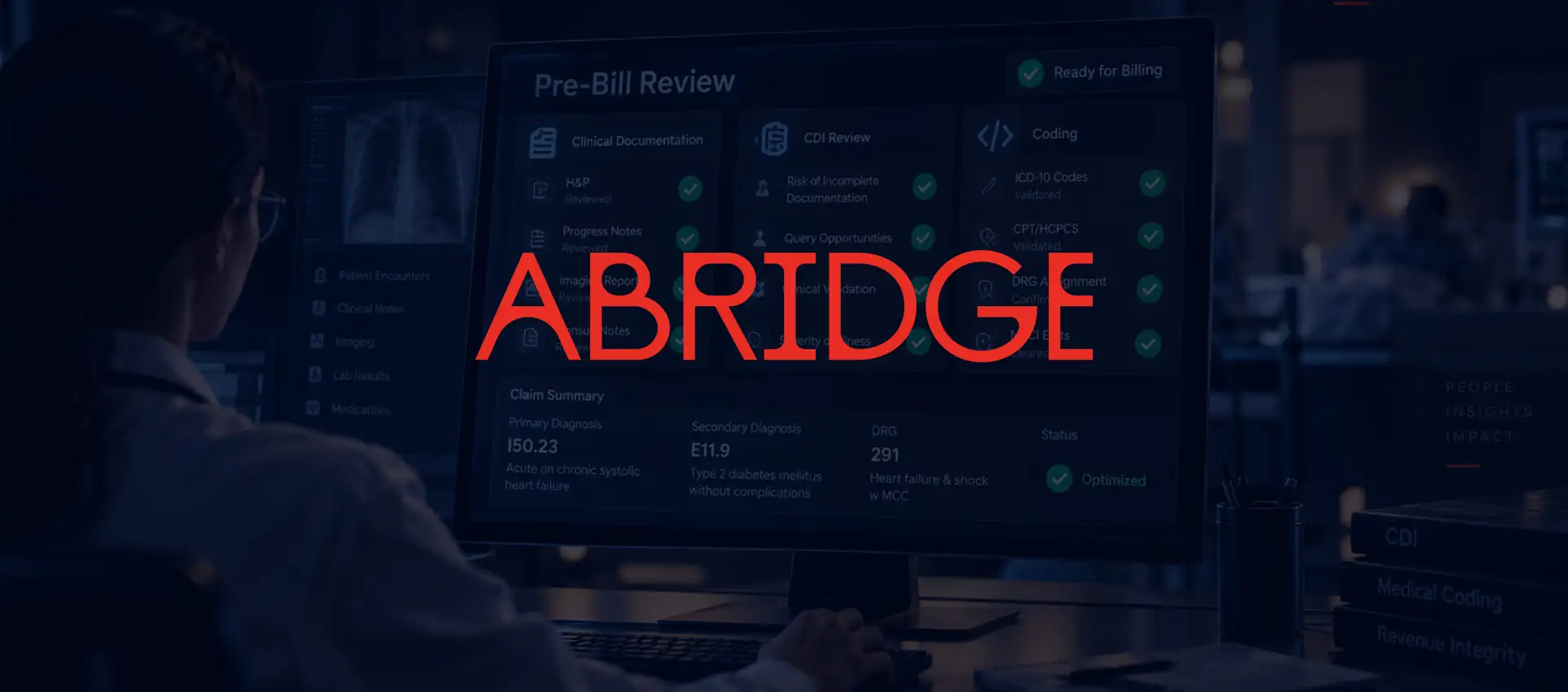
The tool reviews inpatient claims before submission, comparing coded diagnoses and diagnosis-related groups (DRGs) with clinical documentation to identify potential discrepancies and surface supporting evidence.
Abridge has expanded its AI platform into the mid-revenue cycle with a pre-bill claim review capability designed for clinical documentation integrity (CDI), coding, and revenue cycle teams. The tool reviews inpatient claims before submission, comparing coded diagnoses and diagnosis-related groups (DRGs) with clinical documentation to identify potential discrepancies and surface supporting evidence.
The company said the capability allows CDI and coding teams to determine before submission whether the coded record accurately reflects the documented complexity of care.
Abridge began with ambient listening and AI-powered clinical notes and has expanded beyond clinical documentation into other administrative workflows through what it describes as a “clinical intelligence” platform. The company has built its platform around the clinical conversation and is expanding both upstream into visit preparation and downstream into administrative and revenue cycle workflows.
According to Abridge, its technology captures the clinical record as interactions happen and extends that context into reimbursement workflows. The pre-bill review capability compares the clinical record with the diagnoses and DRG on a claim and identifies where they do not align.
The company said the tool does not change documentation, codes, or claim status. CDI teams retain control over what to hold, correct, or release.
“Health systems aren't reimbursed for the care that they deliver. They're reimbursed for the care they document that they delivered,” Shiv Rao, M.D., CEO and co-founder of Abridge, said in a statement.
Abridge said it works with 300 of the largest and most complex health systems in the US, and its platform is expected to support more than 100 million patient-clinician conversations this year.
The pre-bill review tool is the first product in Abridge’s portfolio built for the mid-revenue cycle. The company said it is part of a growing set of capabilities designed to follow a case from the clinical conversation through to the submitted claim.
Abridge is also working with Highmark Health to co-design an AI-powered prior authorization solution at the point of care. In January, the company announced a partnership with health information network Availity to develop AI-powered prior authorization capabilities.
Reid Health is among the health systems working with Abridge. Muhammad Siddiqui, Reid Health’s chief digital and information officer, said the pre-bill capability will be rolled out to its CDI and coding teams.
When the tool identifies a discrepancy, it surfaces the supporting documentation for CDI teams to review through their existing query workflow. It can also help teams assess whether a condition was present on admission (POA), a determination that affects hospital-acquired condition (HAC) reporting and publicly reported quality scores.
Abridge is entering a growing AI-powered revenue cycle market that includes companies such as Waystar, Solventum, Ambience, OpenEvidence, and CodaMetrix.
Healthcare AI spending reached $1.4 billion in 2025, according to Menlo Ventures. Ambient clinical documentation accounted for $600 million of that investment, while coding and billing automation attracted $450 million.
Stay tuned for more such updates on Digital Health News
Follow us