The MedTech Rulebook: How India Is Shaping the Future of Medical Device Governance

The New HealthTech Infrastructure: Why Data & Interoperability Matter More Than Apps

The New HealthTech Infrastructure: Why Data & Interoperability Matter More Than Apps

“More than 110 crore health records are now linked with ABHA, while over 5.47 lakh health facilities and 10.50 lakh healthcare professionals are registered under India’s digital health ecosystem.”

For years, healthcare technology has been marketed through the language of apps. Download a health app, book an appointment, consult a doctor, track your vitals, store a prescription. But the next phase of digital healthcare will not be defined by how many apps patients have on their phones. It will be defined by whether the systems behind those apps can actually communicate.

That is the less visible and arguably more important story of HealthTech.

India has already begun building this underlying infrastructure through the Ayushman Bharat Digital Mission (ABDM). Its architecture is designed around digital identities, health-facility and professional registries, consent-based information exchange and common standards. The objective is not simply to digitise healthcare, but to make different parts of the healthcare system interoperable.

The App is Only the Front Door

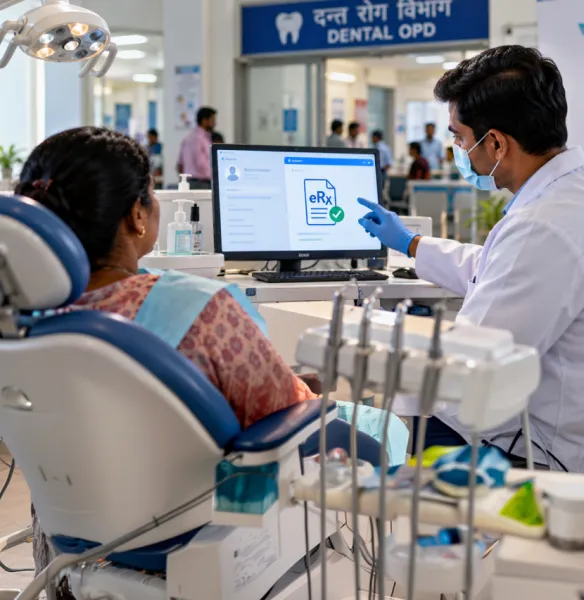
A polished health app may make healthcare easier to access, but it cannot solve fragmentation on its own. Consider a patient who visits a local clinic, undergoes a diagnostic test at another facility and later consults a specialist at a hospital. If every provider stores information in a different system, the patient may still have to carry reports, repeat tests and explain their medical history each time.

The problem is not a lack of digitisation. It is a lack of connection between digital systems. Interoperability changes that equation. When systems can exchange information using common standards, a patient's relevant medical history can move with them, with appropriate consent and rather than remaining locked inside individual hospitals or applications. That is why the real HealthTech infrastructure is increasingly being built beneath the interface.

India’s Digital Backbone

ABDM is perhaps the clearest example of this transition. As of August 12, 2026, India had created 96.43 crore ABHA health identities, linked more than 110 crore health records, registered over 5.47 lakh health facilities and more than 10.50 lakh healthcare professionals. The scale matters, but the architecture matters even more. ABDM brings together building blocks including the ABHA, Health Facility Registry, Healthcare Professionals Registry, Health Information Exchange and Consent Manager, Unified Health Interface and National Health Claims Exchange. Together, these components are intended to create a network rather than another standalone platform. That distinction is crucial. A platform centralises activity. A network allows different participants to connect.

Data Without Silos

The value of health data is rarely in its existence alone. Its value lies in whether it can be understood and used at the right moment. A laboratory report trapped inside one hospital's software has limited utility outside that institution. The same report, when structured and exchanged securely with another authorised provider, can become part of a longitudinal clinical picture.

India has been working towards this through common health-data standards and interoperability frameworks. The Ministry of Health and Family Welfare has noted that ABDM uses common standards and registries to enable different digital health systems across public and private healthcare providers to exchange information. This can have practical consequences: fewer repeated investigations, faster access to medical history, more informed clinical decisions and potentially better continuity of care.

The ambition is therefore bigger than “paperless healthcare.”

It is connected healthcare.

The Private Sector is Part of the Network

Interoperability becomes meaningful only when it extends beyond government platforms. That is already beginning to happen. In May 2026, the government reported that more than 450 public and private HealthTech solutions had integrated with the ABDM ecosystem.

The ecosystem includes hospital information systems, personal health-record applications and AI-enabled platforms. Government examples have highlighted solutions such as eClinicalWorks, EkaCare and Plus91 using ABDM-enabled infrastructure for health records and clinical workflows. This is where India's digital-health strategy becomes particularly interesting.

The goal is not necessarily to build one government application for every healthcare need. It is to create infrastructure on which multiple innovators can build. That is closer to how digital public infrastructure succeeds in other sectors: shared rails, competing services.

There is a danger in celebrating data growth without asking what happens to that data. Health information is among the most sensitive categories of personal information. Interoperability therefore has to be accompanied by consent, security, access controls and accountability. ABDM's architecture follows a consent-based model and emphasises privacy by design rather than creating a single central repository of everyone's health data. Digital-health applications integrating with ABDM also undergo validation and security-related processes.


But technology alone cannot eliminate risk. The larger the ecosystem becomes, the greater the importance of governance, cybersecurity, data quality and responsible access. A connected system that is poorly secured can potentially create vulnerabilities at a scale that disconnected systems never could.

The Next HealthTech Advantage

The biggest opportunity now lies in moving from digitised records to usable intelligence. Once health information becomes more structured and interoperable, technologies such as AI can potentially work with richer clinical context. Decision-support tools can draw from more complete records. Hospitals can reduce administrative duplication. Patients can gain greater continuity across providers. But this only works when the underlying data is accurate, standardised and accessible through appropriate consent.


In other words, AI may be the visible future of HealthTech, but interoperable data is the infrastructure that makes that future possible.

Beyond the App Economy

The first generation of digital healthcare asked: What app should we build? The next generation needs to ask a different question: What infrastructure will allow healthcare systems to work together?

India's progress under ABDM suggests that the country is beginning to make that transition. The scale of ABHA adoption, linked health records and registered facilities demonstrates that the foundations are no longer theoretical. The harder task now is ensuring that these digital rails translate into meaningful clinical value and not simply larger dashboards and bigger databases. Because the future of HealthTech may not belong to the app with the most features. It may belong to the ecosystem in which every useful piece of health information can securely reach the right person, at the right time, with the patient's consent.


And as India builds this new digital health infrastructure, the real question is: can interoperability become the invisible standard that makes healthcare feel genuinely connected?

Stay tuned for more such updates on Digital Health News

Follow us

More Articles By This Author


Show All

Sign In / Sign up