




IISc Develops Molecular-Scale Technology that Mimics Brain Functions
At the same time, neuromorphic computing has faced challenges in identifying materials that naturally combine memory and computation.
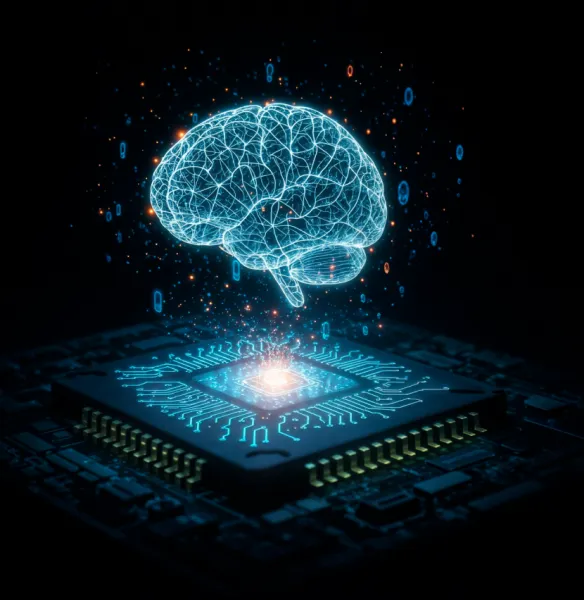
Scientists at the Indian Institute of Science have reported a new advance in molecular electronics, demonstrating devices built from specially designed molecules that can adapt their behaviour and perform multiple computing functions within the same material.
The research brings together chemistry, physics, and electrical engineering, showing that tiny electronic devices at the molecular scale can switch roles based on electrical stimulation. The same device can function as a memory unit, a logic gate, an analogue processor, or an artificial synapse that mimics learning in the brain.
For years, molecular electronics has been explored as a possible path beyond conventional silicon-based devices. However, complex interactions between electrons, ions, and molecular structures have made reliable control difficult. At the same time, neuromorphic computing has faced challenges in identifying materials that naturally combine memory and computation.
The IISc study suggests these challenges can be addressed together. The team designed and synthesised 17 variants of ruthenium-based molecular complexes, adjusting chemical ligands and surrounding ions to control how electrons move through thin molecular films.
These chemical variations enabled the devices to show a wide range of behaviours, from sharp digital switching to smooth analogue responses across multiple conductance levels. “It is rare to see adaptability at this level in electronic materials,” said Sreetosh Goswami, assistant professor at CeNSE. “Here, chemical design directly determines how computation happens.”
The molecular synthesis was carried out by Pradip Ghosh, Ramanujan Fellow at CeNSE, along with Santi Prasad Rath, a former doctoral student. Device fabrication and testing were led by Pallavi Gaur, the study’s first author and a PhD student. “What stood out was how much functionality was hidden in the same system,” Gaur said. “With the right chemistry, one device can store information, process it, or even learn and forget.”
Stay tuned for more such updates on Digital Health News
Follow us