From Generics to Genius: How AI is Transforming Indian Pharma

India has long been called the “pharmacy of the world.” From producing 60% of the globe’s vaccines to supplying affordable generic medicines to millions, Indian pharmaceutical companies have built a reputation for efficiency and reliability. Yet behind the statistics and manufacturing plants lies a quiet revolution, one driven not by manpower alone, but by artificial intelligence. Today, AI is shaping the way Indian pharma innovates, manages supply chains, personalizes care, and envisions the future of medicine.
In 2023, India ranked as the third-largest pharmaceutical producer by volume, accounting for 20% of global generic drug exports. According to IMARC Group, the market is projected to reach USD 174.31 billion by 2033, with AI adoption playing a pivotal role in achieving this growth.
Globally, AI in drug discovery, valued at USD 1.8 billion in 2024, is expected to reach USD 14 billion by 2033, growing at a CAGR of 23.17%. In India, half of the pharmaceutical firms are experimenting with GenAI proof-of-concept initiatives, and a quarter have implemented AI solutions in live production environments.
Accelerating Drug Discovery: Machines as the New Scientists
Traditionally, developing a new drug has been a laborious, multi-billion-dollar endeavor. AI is now taking on the role of a tireless research partner. By sifting through massive datasets, AI algorithms identify promising molecules, simulate their behavior, and predict drug-target interactions with a speed unmatched by human researchers.
Indian companies are investing in AI platforms capable of virtually screening millions of compounds. Machine learning models analyze protein structures and genetic variations, uncovering therapeutic leads that might have remained hidden in conventional labs. The Center of Excellence for AI in Healthcare (AI-CoE), a collaboration between IIT Delhi and AIIMS Delhi, launched in 2025 with INR 330 crore funding, exemplifies India’s drive to develop indigenous AI solutions to expand healthcare access, particularly for underserved communities.
Meanwhile, India’s biotech startup ecosystem, now exceeding 10,000 firms, is increasingly AI-driven. Startups in oncology, infectious diseases, and neurology are creating therapies tailored to the Indian population. Companies like PopVax in Hyderabad are developing mRNA vaccines using AI-driven protein modeling, while Indegene in Bangalore uses generative AI for pharmacovigilance and content creation.
Predictive Analytics: Foreseeing the Demand
India’s healthcare needs are diverse and dynamic. Disease prevalence varies by region, seasonal illnesses spike unpredictably, and urban and rural healthcare infrastructures differ dramatically. AI-driven predictive analytics is now helping pharmaceutical companies forecast demand with precision.
By integrating epidemiological reports, pharmacy sales, weather data, and demographic patterns, AI tools guide inventory planning and production schedules. These insights are critical in preventing shortages of essential medicines during monsoon-related infections or winter respiratory surges. The result: a supply chain that adapts in real time, reducing waste and operational costs while ensuring timely access to life-saving drugs.
Personalized Medicine: Tailoring Treatment Like Never Before
AI is revolutionizing how doctors prescribe treatment in India. By analyzing genetics, lifestyle, and clinical history, AI systems can recommend personalized therapies and dosing regimens, flagging potential adverse reactions.
For instance, MedMitra AI in Jaipur expanded its AI-based diagnostic and treatment platform with INR 3 crore in funding, while Apollo Cancer Centre in Bengaluru launched India’s first AI-Precision Oncology Centre. By integrating genomic, clinical, and pathological data, these initiatives tailor cancer care to each patient, monitor adherence, and even suggest adaptive treatment adjustments in real time.
Such systems are extending beyond oncology, targeting prevalent chronic diseases like diabetes, cardiovascular conditions, and neurological disorders. AI helps identify population-specific genetic markers, enabling treatments that are not only more effective but also safer for Indian patients.
Supply Chain and Distribution: Smarter, Faster, Greener
Pharma supply chains in India are notoriously complex. AI is now being deployed to optimize logistics, reduce delays, and maintain medicine quality, even in remote regions. Route optimization tools incorporate real-time traffic, weather conditions, and demand forecasts, minimizing transit times and fuel usage.
Cold chain monitoring for vaccines and biologics is another critical application. AI systems, paired with IoT sensors, continuously track temperature and environmental conditions, ensuring the integrity of sensitive drugs. Platforms like Hospkart.com streamline procurement for hospitals and clinics, connecting them with vetted suppliers and enabling automated inventory reordering, reducing human error and enhancing responsiveness.
Ensuring Quality and Compliance
Maintaining quality in pharmaceutical manufacturing is a non-negotiable priority. AI-powered systems enhance quality control and regulatory compliance by automating anomaly detection on production lines, inspecting tablets and packaging, and monitoring machinery health.
GE HealthCare’s OnWatch Predict platform, for instance, tracks MRI equipment performance, reducing downtime by 40% in India and preserving batch integrity. Similarly, AI supports statistical process control, predicting deviations before they escalate, reducing defects, and mitigating recall risks.
Chatbots and Patient Engagement: Closing the Communication Gap
AI chatbots are bridging the communication gap between healthcare providers, pharma companies, and patients. Platforms like CureBay operate over 150 eClinics in rural India, combining AI, IoT diagnostics, and hybrid care models. These systems provide patients with timely instructions, manage therapy adherence, and collect real-world outcome data to improve post-market surveillance. For doctors, AI chatbots deliver instant access to drug databases, clinical trial data, and treatment protocols, making decision-making faster and more informed.
AI for Sustainability: Reducing Environmental Footprints
Beyond clinical impact, AI is contributing to sustainable pharmaceutical manufacturing. Systems monitor energy consumption, optimize water usage, and reduce chemical waste. AI can adjust operations during off-peak hours or optimize reaction conditions to conserve resources without compromising production.
Merck’s modular GMP manufacturing line, developed with Siemens and Germany’s Economic and Climate Ministry, exemplifies energy-efficient AI-driven production. Similar AI applications are emerging in India, helping firms meet environmental regulations while reducing costs.
Market Growth and Segmental Insights
India’s pharmaceutical sector is expanding across all segments:
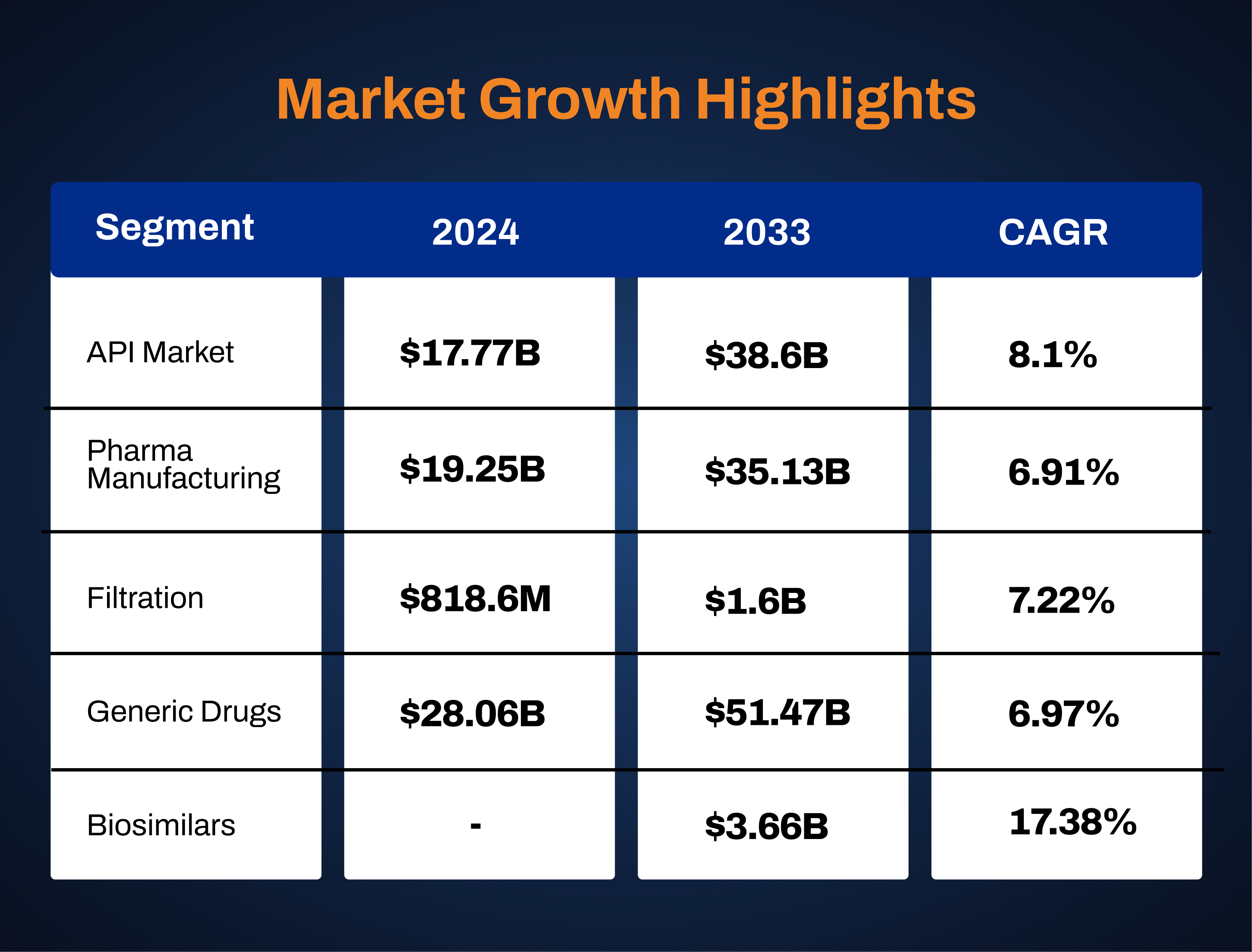
AI is central to these expansions, driving efficiency, improving product quality, and enabling precision in manufacturing and R&D.
Strategic Imperative: AI as a Growth Engine
AI is no longer an optional tool—it is a strategic necessity. Over 85% of biopharma executives in 2025 reported active investments in AI for supply chain optimization, R&D acceleration, and market competitiveness. Companies are moving toward end-to-end AI integration, from in-silico drug discovery to post-market surveillance, rather than retrofitting legacy systems. Public-private partnerships, such as AI-CoEs in AIIMS Delhi, Rishikesh, and PGIMER Chandigarh, are further fostering innovation in healthcare AI.
Government policies like the Production Linked Incentive (PLI) scheme and NITI Aayog’s National AI Strategy incentivize AI adoption, offering financial and structural support to firms integrating AI into drug development, clinical trials, and supply chain management.
Challenges in Adoption
Despite tremendous potential, AI adoption in India faces hurdles. Complex datasets require robust data architectures, and smaller firms struggle with investment demands. The need for AI talent has quadrupled since 2022, creating a shortage that must be addressed through reskilling programs. Regulatory compliance, ethical standards in clinical trials, and data privacy remain key concerns. Companies must enhance collaboration with academia, invest in scalable data systems, and develop ethical AI frameworks to fully realize AI’s benefits.
The Road Ahead: India as a Global Healer
India’s pharmaceutical industry is projected to double to USD 130 billion by 2030 and could reach USD 450 billion by 2047, with AI as a central driver. By accelerating R&D, enabling personalized medicine, strengthening supply chains, and enhancing sustainability, AI is positioning India not only as a global supplier of affordable medicines but also as a leader in healthcare innovation.
The country’s low-cost skilled labor, robust infrastructure, and vibrant biotech ecosystem provide fertile ground for AI-driven pharma. By addressing challenges in talent, regulation, and data management, Indian companies are poised to transition from generics suppliers to global innovators and healers, shaping the future of healthcare with precision, efficiency, and affordability.
With AI as the catalyst, India is no longer just the “pharmacy of the world”; it is a laboratory, a think tank, and a healing hub, writing the next chapter in global medicine.
Stay tuned for more such updates on Digital Health News
Follow us