India Unveils First Indigenous Quantum Diamond Microscope for Advanced Magnetic Field Imaging
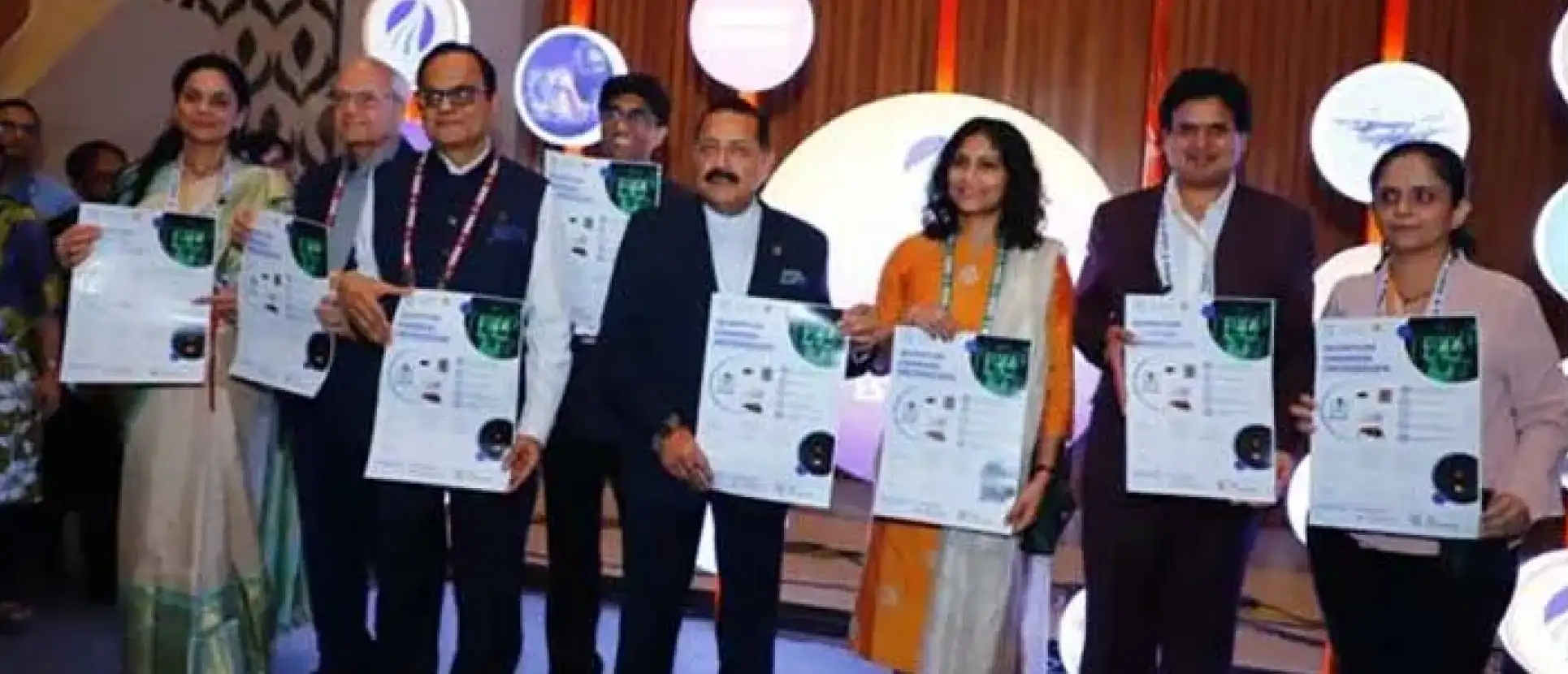
The microscope, designed for dynamic magnetic field imaging, marks a major milestone in quantum sensing and has earned India its first patent in this field.
India’s first indigenous Quantum Diamond Microscope (QDM), developed by the P-Quest Group at IIT Bombay under the National Quantum Mission (NQM) of the Department of Science and Technology (DST), has been unveiled.
The announcement took place at the Emerging Science Technology and Innovation Conclave (ESTIC 2025).
The microscope, designed for dynamic magnetic field imaging, marks a major milestone in quantum sensing and has earned India its first patent in this field. The development was announced in the presence of Union Minister for Science and Technology Dr. Jitendra Singh, Principal Scientific Adviser Prof. Ajay K. Sood, and DST Secretary Prof. Abhay Karandikar.
The Quantum Diamond Microscope, developed by the PQuest Group led by Professor Kasturi Saha, is based on nitrogen-vacancy (NV) centers in diamond and enables three-dimensional magnetic field imaging at the nanoscale. The NV centers—atomic-scale defects formed by a nitrogen atom adjacent to a vacancy—exhibit robust quantum coherence even at room temperature, making them highly sensitive to magnetic, electric, and thermal variations. Their spin-dependent fluorescence, detected through optically detected magnetic resonance (ODMR), allows optical readout of local magnetic fields.
By engineering a thin diamond layer with high NV density, the QDM facilitates widefield imaging of dynamic magnetic activity, similar to optical microscopy. The technology is expected to play a key role in non-destructive evaluation of semiconductor chips, enabling 3D magnetic mapping within encapsulated chips.
As 3D chip architectures gain prominence in electronics, conventional diagnostic tools face limitations in visualizing buried current paths and multilayer charge flow. The QDM provides a direct, high-resolution approach for imaging integrated circuits, batteries, and microelectronic devices.
Aligned with the objectives of the National Quantum Mission, Prof. Saha’s team aims to integrate the QDM with AI/ML-based computational imaging, extending its applications to chip diagnostics, biological imaging, and geological magnetization studies.
Stay tuned for more such updates on Digital Health News
Follow us