90 Cr ABHA IDs, 100 Cr Linked Records: Why India's EHR Market Matters Now

90 Cr ABHA IDs, 100 Cr Linked Records: Why India's EHR Market Matters Now
Advertisement

India’s healthcare system is no longer simply digitizing. It is being rewired.

What began as a hospital-level shift from paper to software is now becoming a national transformation in how health data is created, connected, governed, and used across the care continuum. The journey from Hospital Information Systems to EMRs, EHRs, ABDM, and eventually AI-driven health intelligence marks one of the most important structural shifts in Indian healthcare.

The scale is now difficult to ignore.

India has crossed more than 90 crore Ayushman Bharat Health Accounts, or ABHA IDs, creating one of the world’s largest digital health identity layers. More importantly, over 100 crore health records have now been linked with ABHA, signalling that ABDM is moving beyond identity creation into actual health data connectivity.

At the same time, India’s Electronic Health Records market is gaining momentum. The market is estimated at roughly USD 726–739 million in 2025 and is projected to reach around USD 1.4–1.5 billion by 2033–2034. This growth is being driven by hospital digitization, cloud-based clinical systems, ABDM-aligned interoperability, and the rising need for structured patient data.

Taken together, these developments show that India is not merely digitizing healthcare records. It is laying the foundation for a national health intelligence layer in which patient data can be continuous, portable, consent-based, and clinically actionable across providers, geographies, and over time.

But the milestone is not the destination. The real test begins now: whether hospitals, clinicians, health-tech companies, insurers, public health systems, and policymakers can turn this digital infrastructure into better continuity of care, safer decisions, reduced duplication, stronger governance, and improved patient experience.

The Starting Point: How HIS Systems Built India’s First Digital Layer

To understand where India stands today, it is important to recognize that the journey toward connected health records did not begin with EHRs. It began with Hospital Information Systems, or HIS.

HIS platforms served as the first major layer of digitization inside Indian hospitals. They were primarily designed to solve operational complexity: patient registration, billing, admissions, discharge processes, pharmacy workflows, laboratory operations, inventory management, and internal hospital administration.

For high-volume hospitals, especially large private hospital chains and tertiary care institutions, HIS systems brought much-needed process control. They reduced paperwork, improved coordination across departments, helped hospitals manage scale, and gave administrators better visibility into operations.

By the early 2010s, many large private hospital networks in metropolitan India had already adopted HIS platforms as the backbone of hospital operations. For administrators, this was a turning point. Hospitals could now standardize processes, track transactions, reduce manual dependencies, and improve internal efficiency.

However, HIS systems were fundamentally institution-centric. They helped hospitals run better, but they were not designed to create a longitudinal view of the patient. A patient treated across multiple hospitals, clinics, diagnostic centers, and pharmacies still had fragmented records. There was no common patient-linked data layer. There was no seamless way to consolidate clinical history across care settings.

This limitation became increasingly visible as Indian healthcare became more fragmented and patients began moving across multiple providers, cities, and care models.

HIS solved the hospital operations problem. It did not solve the patient continuity problem. That gap led to the rise of EMRs.

The Clinical Layer: EMRs &the Digitization of Patient-Level Data

Electronic Medical Records marked the next phase of India’s digital health journey. EMRs moved digitization from the administrative layer to the clinical layer.

Instead of focusing only on billing, admissions, and hospital workflows, EMRs allowed doctors and care teams to capture consultations, prescriptions, diagnoses, lab reports, imaging references, treatment notes, discharge summaries, and patient histories in a structured digital format.

This changed how clinicians accessed and used patient data within hospitals and clinics. Doctors could view patient histories more easily. Departments such as pathology, radiology, pharmacy, nursing, and clinical specialties could coordinate better. Hospitals could reduce duplication of tests, improve documentation accuracy, and create a more reliable internal clinical record.

The impact has been particularly visible in large hospital networks, specialty hospitals, outpatient chains, and high-volume clinics where speed, documentation, and care coordination matter deeply.

From a market perspective, India’s clinical records software market is now entering a more mature phase. EHR market estimates place the 2025 market size at roughly USD 726–739 million, with projections reaching around USD 1.4–1.5 billion by 2033–2034.

However, it is important to note that in many market reports and industry conversations, the terms EMR and EHR are often used interchangeably. Conceptually, though, the distinction matters.

An EMR usually digitizes the patient record within one institution or care setting. An EHR is designed to support a broader, longitudinal, interoperable view of the patient across multiple providers and systems. That difference is central to India’s next digital health leap. EMRs digitized clinical data, but in most cases they still remained confined within institutional boundaries. A patient visiting multiple providers could still have disconnected records across multiple systems. This created a paradox. Healthcare was becoming digital, but not yet connected. The next stage required interoperability.

The Interoperability Shift: EHRs & the Emergence of Connected Healthcare

Electronic Health Records represent a deeper shift in how healthcare data is structured, exchanged, and used.

Unlike EMRs, which usually operate within a hospital, clinic, or provider network, EHRs are designed to enable data portability and interoperability across the broader healthcare ecosystem. They allow patient data to move across hospitals, clinics, laboratories, diagnostic centers, pharmacies, insurers, and public health systems.

For patients, this means their health information can follow them over time. For doctors, it means access to a fuller clinical context. For hospitals, it means better coordination and reduced duplication.

For policymakers and public health leaders, it means the possibility of more reliable population-level insights.

This is especially important in India, where healthcare delivery is highly fragmented. Patients often move between public and private providers, between primary and tertiary care, between cities and districts, and between allopathic and alternative systems of care. In such an environment, interoperability is not a technical luxury. It is a foundational requirement.

The faster growth of cloud-based and web-based EHR platforms reflects this shift. Healthcare providers are increasingly looking for systems that are not only digital, but also scalable, interoperable, ABDM-ready, analytics-friendly, and easier to deploy. However, India’s transition to true EHR maturity is still underway.

Many systems described as EHRs today are, in practice, advanced EMRs with limited interoperability. The shift toward fully functional EHR ecosystems will depend on standardized data formats, API adoption, consent-based data sharing, stronger cybersecurity, better clinical workflows, and deeper integration with national digital health infrastructure.

This is where ABDM becomes central.

ABDM: Building the Rails for a Connected Health Ecosystem

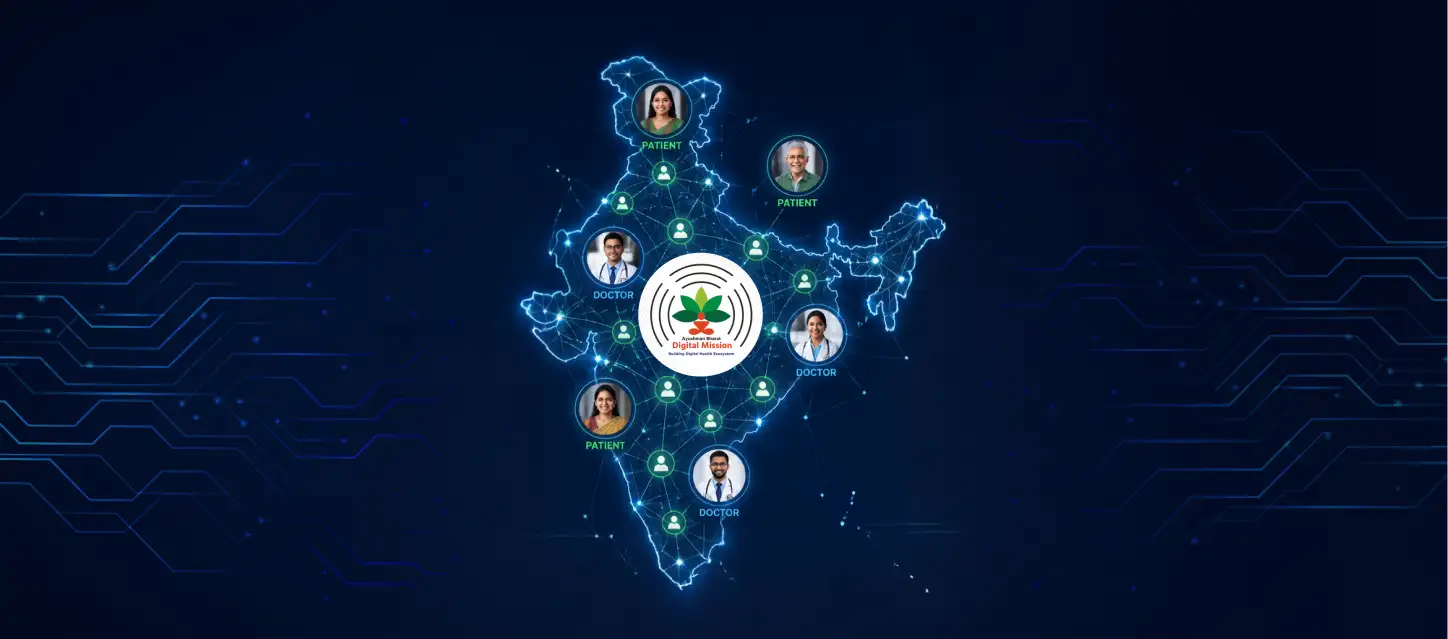
The Ayushman Bharat Digital Mission is the most significant structural intervention in India’s digital health journey. It is not simply a government technology program. It is an attempt to build the foundational rails for a connected, consent-based, patient-centric health data ecosystem. At the heart of ABDM is the ABHA ID, a unique digital health identity that allows citizens to link, access, and share their health records with consent. This addresses one of India’s long-standing healthcare challenges: the absence of a common patient identifier across healthcare providers.

The scale is historic. India has now crossed more than 90 crore ABHA accounts. Over 100 crore health records have been linked with ABHA. Public and private digital health solutions are increasingly integrating with ABDM. This shows that India’s digital health infrastructure is moving from concept to execution at national scale.

What makes ABDM important is its architecture. It is built around three critical layers: identity, consent, and interoperability. The identity layer allows patients to be recognized across systems.

The consent layer gives patients control over how their health data is shared. The interoperability layer enables different health systems to exchange data in a structured way.

This architecture shifts the digital health conversation from hospital-owned data to patient-linked data. It creates the possibility of longitudinal health records that are not trapped inside one institution.

However, infrastructure alone will not create transformation.

The next challenge is adoption. Hospitals must integrate ABDM into real clinical workflows. Doctors must be able to access useful patient records without additional friction. Patients must understand consent-based data sharing. Health-tech companies must build ABDM-native platforms. Policymakers must ensure governance, privacy, and security. And the broader ecosystem must move from record linkage to record usefulness. The number of linked records is a major milestone.

But the quality, completeness, structure, and clinical usability of those records will determine whether India can truly move from digital health infrastructure to digital health intelligence.

Cloud & AI: Reshaping the Next Generation of Clinical Systems

India’s EMR and EHR ecosystem is also being reshaped by cloud computing and artificial intelligence. Cloud-based platforms are becoming the preferred direction for new deployments. Compared to traditional on-premise systems, cloud-based EHR platforms offer faster implementation, easier scalability, lower infrastructure burden, real-time data synchronization, and smoother integration with national frameworks such as ABDM. This is especially relevant for India, where healthcare providers range from large enterprise hospital chains to mid-sized hospitals, clinics, diagnostic centers, and emerging care networks. Cloud-native platforms can reduce the entry barrier for digitization and make advanced capabilities more accessible.

AI is adding another layer of transformation. The next generation of EMR and EHR systems will not be passive repositories of patient data. They will increasingly support documentation automation, clinical summarization, decision support, population risk identification, care gap analysis, patient engagement, and operational intelligence.

This shift is already visible globally and is beginning to emerge in India as well. AI-enabled documentation tools, smart prescription systems, diagnostic automation, clinical workflow assistants, and analytics platforms are moving closer to everyday care delivery.

However, AI will only be as strong as the data foundation beneath it.

If records are fragmented, incomplete, unstructured, or poorly governed, AI will struggle to deliver reliable clinical value. This is why India’s EHR conversation must now move beyond software adoption to data readiness. The next phase of healthcare AI in India will depend on the quality of EMR adoption, the maturity of EHR interoperability, and the strength of consent-led data governance.

India’s EMR & EHR Ecosystem: A Multi-Layered Market

India’s EMR and EHR ecosystem is not dominated by a single type of platform. It is a multi-layered market shaped by the diversity of Indian healthcare itself.

Patient-centric platforms are focused on helping individuals build longitudinal health records and access their information across care settings. These platforms align closely with ABDM’s vision of patient-controlled health data. Doctor-centric platforms are designed for outpatient environments where speed, ease of use, prescription generation, and minimal consultation disruption are critical. These solutions are particularly relevant for clinics, specialists, and high-volume OPD settings.

Cloud-native hospital platforms are emerging for hospitals that need scalable, integrated, and interoperable systems without heavy on-premise infrastructure. These platforms are often better positioned for ABDM alignment and faster deployment.

Enterprise hospital systems continue to support larger hospital networks with customized HIS, EMR, billing, operational, and clinical modules. These systems remain deeply embedded in hospital workflows and will play an important role in India’s transition toward interoperability.

AI-driven platforms are pushing the boundaries of automation, documentation, diagnostics, and clinical intelligence. They are helping bridge the gap between data capture and decision support.

This diversity reflects the reality of Indian healthcare.

A small clinic, a diagnostic chain, a district hospital, a corporate hospital network, a medical college, and a national health-tech platform do not have the same needs. India’s digital health ecosystem will therefore not be built by one type of system. It will be built by a layered market of specialized platforms that can connect through common standards, APIs, and consent frameworks.

Global Benchmark: What Mature EHR Ecosystems Teach Us

Mature EHR markets offer useful lessons for India, but they cannot be copied blindly. In countries such as the United States, large platforms such as Epic and Oracle Health dominate enterprise hospital networks.

Ambulatory platforms such as Athenahealth and eClinicalWorks support outpatient and physician practice environments. These systems are deeply integrated with clinical workflows, insurance claims, billing, regulatory reporting, analytics, and patient engagement. What distinguishes mature EHR ecosystems is not just the presence of software.

It is ecosystem integration. Interoperability, cloud adoption, patient portals, clinical documentation, claims integration, analytics, cybersecurity, and regulatory compliance are built into the operating model of healthcare delivery. For India, the opportunity is even larger because the country is building digital health infrastructure at population scale. But the complexity is also greater.

India must solve for public and private healthcare, urban and rural settings, large hospitals and small clinics, digital-first providers and paper-heavy workflows, multiple languages, affordability constraints, and varying levels of digital maturity.

This makes India’s journey unique. The country is not just adopting EHRs. It is trying to build a national digital health ecosystem for one of the world’s largest and most diverse healthcare populations.

What This Means for India’s Healthcare Ecosystem.

The shift from HIS to EMR to EHR is not just a technology upgrade. It has deep implications for hospitals, clinicians, patients, health-tech companies, insurers, and policymakers.For hospitals, the message is clear: HIS alone is no longer enough. Operational digitization must now be complemented by clinical digitization, interoperability, analytics, cybersecurity, and patient engagement.

For clinicians, the opportunity is better context at the point of care. A longitudinal health record can reduce blind spots, avoid unnecessary repeat tests, improve medication safety, and support more informed clinical decisions.

For patients, the shift creates the possibility of real data ownership. Health information can become portable, consent-driven, and accessible across providers. For health-tech companies, ABDM creates a new market opportunity. The next generation of platforms will need to be ABDM-native, cloud-first, AI-ready, secure, and deeply usable.

For insurers and payers, interoperable records can improve claims processing, fraud detection, risk assessment, care management, and preventive health programs.

For policymakers, the opportunity is population-level insight. Better data can support public health planning, disease surveillance, resource allocation, and outcome measurement.

But these benefits will not happen automatically.

India must now solve the harder problems: workflow adoption, data quality, privacy, cybersecurity, consent literacy, standardization, and trust.

Key Takeaways

First, India has crossed from digital identity creation to health record linkage at scale. The 100 crore linked-record milestone shows that ABDM is moving beyond enrollment into real data connectivity.

Second, HIS remains the operational foundation of hospital digitization, but it is no longer sufficient for the future. Hospitals now need systems that support clinical workflows, interoperability, consent, analytics, and patient engagement.

Third, the EMR and EHR market is entering its second phase. The first phase was digitization. The next phase will be ABDM-aligned, cloud-first, AI-enabled, and governance-conscious.

Fourth, the biggest opportunity is not software installation. It is workflow transformation. Adoption will depend on how easily doctors, nurses, administrators, labs, insurers, and patients can use these systems without adding friction.

Fifth, India’s next digital health leap will depend on data quality. Linked records are only the beginning. Structured, complete, standardized, and clinically useful data will determine whether India can move from digital health infrastructure to digital health intelligence.

Future Outlook: Toward a National Health Intelligence Layer

India’s healthcare system is gradually moving toward a model where data becomes continuous, interoperable, consent-driven, and intelligence-ready.This transformation is unfolding in stages.

The first stage was operational digitization through HIS. The second stage was clinical digitization through EMRs. The third stage is interoperability through ABDM and EHR adoption.

The fourth stage will be AI-driven health intelligence. In this future state, health records will not simply document what happened. They will help predict what may happen next. They will support clinical decisions, identify care gaps, trigger preventive interventions, guide population health strategies, and improve healthcare system planning.

India will remain a hybrid system for some time. Paper records, HIS platforms, EMRs, EHRs, mobile health apps, diagnostic systems, and ABDM-linked records will coexist. But the direction of travel is clear.

Healthcare data is becoming increasingly connected.

The next question is whether it can become meaningfully actionable.

Conclusion: From Digitization to Intelligence-Driven Healthcare

India’s transition from HIS to EMR to EHR represents a fundamental shift in how healthcare operates.

Each stage has moved the system closer to a model where patient data is no longer confined to institutions but becomes part of a continuous, portable, consent-based health record.

With more than 90 crore ABHA accounts, over 100 crore linked health records, a growing EHR market approaching USD 1.4–1.5 billion, and increasing adoption of cloud and AI-enabled platforms, India is building one of the most ambitious digital health ecosystems in the world.

But the next phase will be more demanding than the first. The country has built the digital rails. Now the ecosystem must prove that those rails can improve care continuity, reduce duplication, strengthen trust, protect privacy, empower patients, and enable better clinical and public health decisions.

This is not just digitization. It is the beginning of India’s movement toward a national health intelligence infrastructure. And if executed well, it could redefine how healthcare is delivered, managed, and experienced at scale.

Stay tuned for more such updates on Digital Health News

Follow us

More Articles By This Author


Show All

Sign In / Sign up