IIT Madras Develops Low-Cost Chip Device for Rapid Antibiotic Resistance Testing
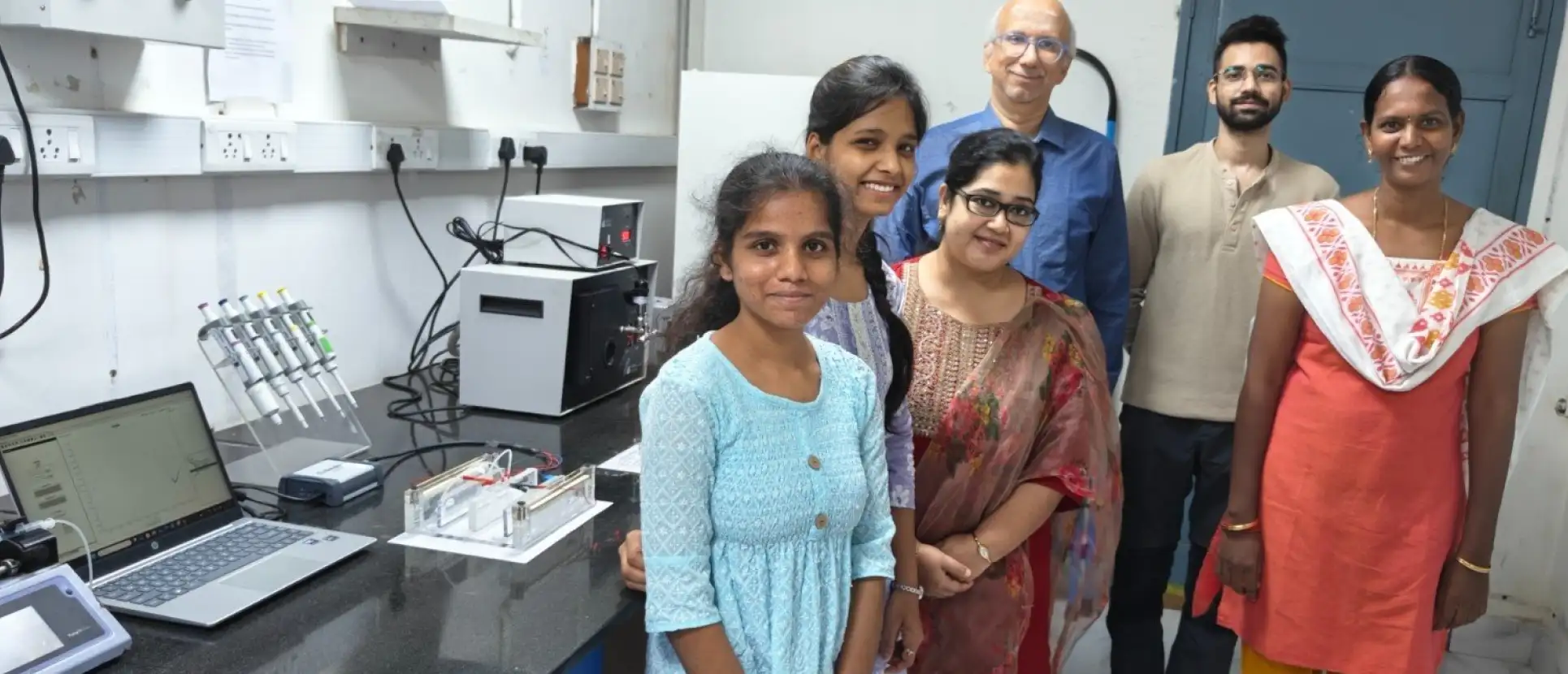
The device, called ε-µD, uses electrochemical signals to assess bacterial growth and antibiotic susceptibility, officials said.
Researchers at the Indian Institute of Technology (IIT) Madras have developed a low-cost microfluidic device that can quickly determine whether bacteria are resistant or susceptible to antibiotics.
The device, called ε-µD, uses electrochemical signals to assess bacterial growth and antibiotic susceptibility, officials said.
Unlike many techniques that rely on expensive metals or complex fabrication processes, the lab-on-chip device is built on screen-printed carbon electrodes embedded in a simple microfluidic chip. Researchers noted that this makes it economical and suitable for smaller clinics and rural healthcare centers.
According to S. Pushpavanam, Y. B. G. Varma Institute Chair Professor, Department of Chemical Engineering, IIT Madras, "The device designed for speed, sensitivity, and ease of use holds strong potential for early diagnosis and better treatment of bacterial infections, particularly in regions with limited access to advanced laboratory infrastructure."
The device can deliver results within three hours and is based on electrochemical impedance spectroscopy. Traditional antimicrobial susceptibility testing (AST) methods, which involve growing bacterial cultures and observing their response to antibiotics, typically take 48 to 72 hours.
"However, traditional AST methods, which involve growing bacterial cultures and observing their response to antibiotics, are labor-intensive and typically take 48 to 72 hours. This delay can lead to the use of broad-spectrum antibiotics as a stopgap, which in turn exacerbates the resistance problem," Pushpavanam said.
The World Health Organization (WHO) has identified antimicrobial resistance (AMR) as one of the top 10 threats to global health. Estimates suggest nearly 4.95 million deaths worldwide in 2019 were linked to bacterial AMR.
To address these challenges, the IIT Madras team developed ε-µD, which they say meets several WHO criteria. "This device meets several key criteria outlined by the WHO, including affordability, speed, ease of use, and reliability. By addressing these priorities, ε-µD takes a significant step toward making antimicrobial susceptibility testing more accessible, especially in low-resource settings," Pushpavanam said.
The findings have been published in Nature Scientific Reports. Pushpavanam explained, "An important aspect of our device is the use of a specially prepared nutrient solution that serves a dual purpose. It not only supports bacterial growth, which is essential for testing, but also enhances the sensitivity of the electrical signals we use for detection. As the bacteria grow, they cause measurable changes in the electrical properties of the solution, which our system can accurately track."
He added, "This approach will make a real impact on patients in intensive care units, who may be suffering from complications due to bacterial infections. This will help the doctors prescribe the right treatment and can be life-saving."
The team is currently conducting clinical validation in collaboration with IITM Institute Hospital and plans to commercialize the device through its startup, Kaappon Analytics India Private Limited.
The researchers tested the device on E. coli and B. subtilis using antibiotics ampicillin and tetracycline to demonstrate its ability to detect different responses.
Stay tuned for more such updates on Digital Health News
Follow us