DHN City Meetup Delhi: Architecting Intelligence, Accountability and the Future of Care
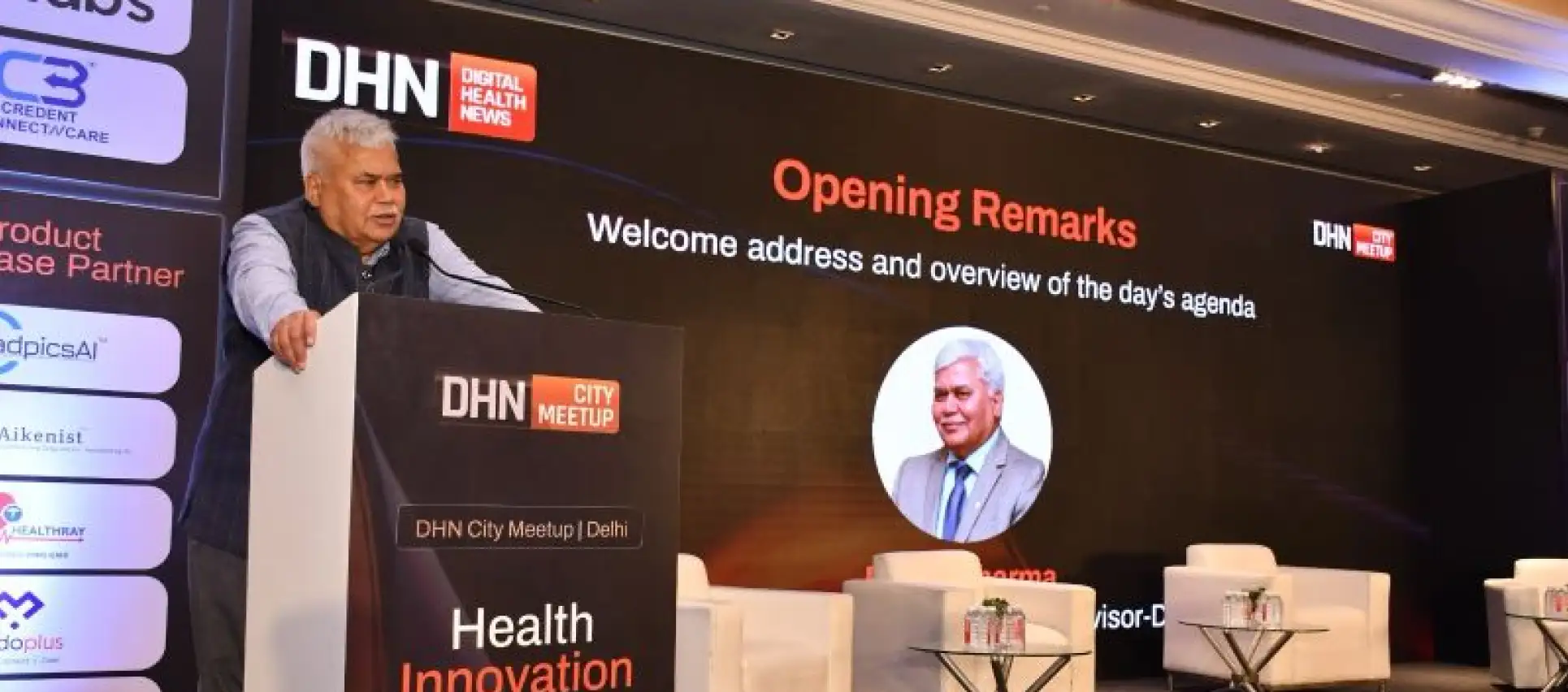
On 21 February 2026, the refined setting of Holiday Inn, Mayur Vihar, New Delhi, became the site of a conversation far more substantive than a routine industry exchange. The Delhi chapter of the DHN City Meetup assembled not to celebrate digitisation as an inevitable trend, but to interrogate its discipline, its governance, and its moral architecture.
In an era where healthcare discourse is saturated with references to artificial intelligence, predictive analytics, interoperability, and smart hospitals, the urgency is no longer about adoption alone. The urgency is about coherence. How do institutions transition from fragmented digital initiatives to integrated, accountable systems that genuinely enhance care delivery?
CIOs, medical directors, nursing leaders, policymakers, and technology strategists gathered with an uncommon seriousness of tone. The room did not carry the cadence of futurism. It carried the weight of responsibility.
The question that framed the day was both simple and profound: Can India’s hospital systems evolve from digitised operations to digitally mature ecosystems anchored in patient-centric design?
Opening Perspective: Digital Infrastructure as a Public Good
The keynote address by Dr. R.S. Sharma, former CEO of the National Health Authority and strategic advisor to DHN, established the philosophical framework for the discussions that followed.
Reflecting on India’s digital public infrastructure journey, he drew a compelling parallel between identity and healthcare portability.
“Aadhaar created a digital identity. Now, healthcare must make that identity portable and accessible,” he stated. “The patient must not just be a beneficiary, but the primary stakeholder.”
His remarks extended beyond technological architecture. They introduced a civic dimension to digital health. Infrastructure, he implied, is meaningful only when it empowers continuity of care, reduces friction, and grants patients ownership of their health records across institutions and geographies.
In that moment, digital transformation was reframed not as a procurement strategy, but as a public service.
Strengthening the Digital Core: Interoperability as Institutional Discipline
As the dialogue transitioned into operational realities, the emphasis shifted toward the foundational systems that quietly determine success or stagnation: HIS alignment, EMR maturity, metadata compliance, and structured data governance.
Dr. Sushil Meher, Chief Information Officer at AIIMS, broadened the institutional lens.
“A hospital is not just a treatment centre; it is a foundation for research and education,” he observed. “Research demands high-quality, standardized data.”
His assertion underscored a critical insight. Without disciplined data architecture, hospitals cannot meaningfully contribute to clinical research, evidence generation, or advanced analytics. Interoperability, therefore, is not merely about system compatibility. It is about ensuring that data retains semantic consistency, structural integrity, and analytical reliability across platforms.
The discussion evolved from technical compliance to cultural adoption.
Prashant Vashisht, Group CIO at Marengo Asia Hospitals, articulated the pragmatic nature of transformation.
“Adoption accelerates when technology demonstrates real value, such as real-time alerts before cardiac events,” he noted. “Change is coming, slowly, gradually, but firmly and consistently.”
His perspective acknowledged the lived complexity of hospital environments. Transformation does not occur through directives; it emerges when clinicians experience tangible improvements in patient outcomes and operational efficiency.
Candid operational realities surfaced through Mohit Tandon, Vice President of IT at Metro Hospitals & Heart Institutes.
“Patients are present in data, but data hygiene has never been done,” he remarked.
Multiple MRNs, fragmented records, and inconsistent cleansing practices continue to dilute digital aspirations. His intervention reframed digital transformation as a matter of governance discipline. Without structured cleansing, standardisation, and clinician engagement, even the most sophisticated systems risk operating on compromised foundations.
Bringing the conversation into the realm of augmented workflows, Praveen Bist, CIO at Amrita Hospitals, illustrated how AI-enabled documentation tools are beginning to reshape clinical practice.
“With AI tools, even doctor-patient conversations can be transcribed and seamlessly integrated into EMR,” he explained. “But technology only works when it becomes an active part of the workflow and users clearly see its benefit.”
The distinction he made was subtle yet decisive. Implementation is not integration. Systems must harmonize with clinical rhythm rather than disrupt it.
Across these perspectives, a shared principle emerged: digital maturity demands structural precision, cultural alignment, and relentless attention to data integrity.

From Intelligence to Responsibility: Governing AI in Clinical Ecosystems
As the discussion deepened, the focus shifted toward artificial intelligence and analytics. Yet the tone remained grounded. AI was not positioned as a replacement for human judgment, but as an instrument requiring ethical clarity and institutional safeguards.
Dr. Madhulika Jain, Head of Medical Services at Max Super Speciality Hospital, Dwarka, introduced a necessary caution.
“It’s not just can AI do this, but should we do this?” she asked. “We are generating more health data than ever before, but are we transforming clinical intelligence or just digitizing complexity?”
Her remarks elevated the discourse beyond efficiency metrics. Data accumulation, she suggested, does not automatically translate into insight. Without contextual interpretation, analytics may amplify complexity rather than resolve it.
Reinforcing the principle of accountability, Archana Atreja, Medical Superintendent at Rajiv Gandhi Cancer Institute and Research Centre, drew a firm boundary around clinical authority.
“AI can suggest, but the final responsibility lies with the clinician,” she stated. “Strong documentation strengthens medical as well as medico-legal safety.”
Her intervention reaffirmed a non-negotiable truth: technology may inform decisions, but accountability remains human.
From the vantage point of nursing leadership, Capt. Bobby Ramesh, Group Director, Nursing Excellence at Sarvodaya Healthcare, addressed readiness at the frontline.
“Staff and nurses training is a must if we implement new technology; they must trust AI and analytics,” he emphasized. “If alerts are not contextual and prioritized, they become noise instead of support.”
His perspective illuminated a critical operational dynamic. Systems that overwhelm caregivers undermine confidence. Systems that prioritize intelligently enhance safety.
Completing the governance framework, Aniket Aman, Data Scientist at Max Healthcare, distilled AI preparedness into three essential pillars.
“True AI readiness depends on trust, governance, and real workflow integration.”
Trust ensures acceptance. Governance ensures accountability. Integration ensures utility. Without these, AI remains aspirational rather than transformational.
Collectively, the dialogue converged on a mature conclusion: artificial intelligence may extend clinical capability, but it cannot substitute clinical judgment. In healthcare, intelligence is inseparable from responsibility.

Designing the Future with Deliberation
As the formal sessions concluded and conversations continued in smaller clusters across the venue, the enduring impression was not technological exuberance but thoughtful deliberation.
The Delhi DHN City Meetup resisted the temptation to romanticize innovation. Instead, it insisted on precision. It demanded interoperable systems built on clean data. It emphasized clinician involvement from design to deployment. It foregrounded ethical governance as a prerequisite for AI expansion.
Most importantly, it repositioned the patient at the centre of digital ambition.
The trajectory of India’s healthcare transformation will not be determined solely by the speed of adoption, but by the integrity of its architecture. Systems must be designed not only to function, but to endure. Not only to automate, but to elevate care delivery.
In Delhi, the message resonated with clarity and conviction: the future of healthcare belongs to institutions that combine technological sophistication with disciplined governance, human judgment, and unwavering patient-centric purpose.
Digital maturity is not a milestone. It is a responsibility.
Stay tuned for more such updates on Digital Health News