



Google CEO Sundar Pichai Highlights Google’s AI Efforts Across Health & Science

Google said collaboration with researchers, governments, healthcare institutions, philanthropic organisations and other partners will remain important as AI applications move from research into practical settings.
Google CEO Sundar Pichai has highlighted the technology giant’s expanding AI efforts across health, scientific research, disaster resilience, learning and economic opportunity, pointing to applications designed to improve disease detection, accelerate research and extend access to healthcare and other services.
Google said its AI technologies now support nearly 300 languages spoken by around 7 billion people, while its AI and research programmes are being applied to challenges across healthcare, climate and education.
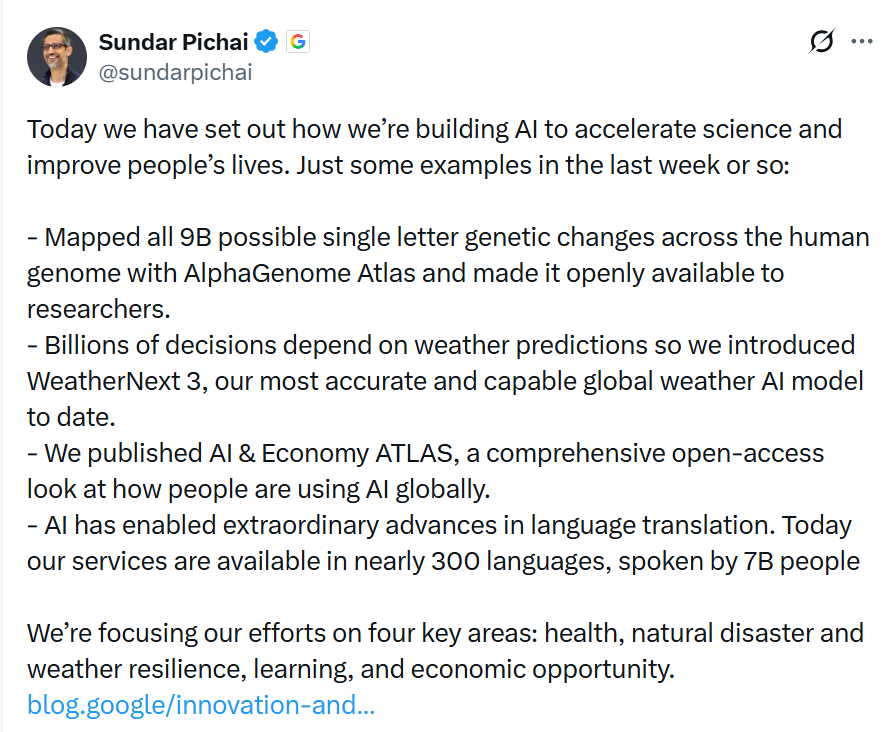
In health, Google has pointed to genomic research as one area where AI is being used to support scientific discovery.
Its AlphaGenome Atlas has mapped all 9 billion possible single-letter genetic changes across the human genome and has been made openly available to researchers.
Google said the work builds on tools including AlphaFold and AlphaMissense, which are being used to study proteins and genetic mutations associated with disease.
Google has also highlighted AI-assisted disease detection. A breast cancer study conducted with Imperial College London and the UK’s National Health Service found that AI detected 25% of interval cancers that had previously been missed in mammograms involving 175,000 women.
Google said it is also developing tools targeting lung cancer, colorectal cancer, and genetic mutations in tumour cells.
Moreover, Google said its chest X-ray technology, used by Nexus Intelligence, has screened more than 25,000 X-rays across 40 locations in six countries to support tuberculosis detection.
Its diabetic retinopathy model has supported more than 1.15 million screenings globally, with Google planning further expansion.
Google has further cited work involving smartphones and wearable devices to support early detection of cardiovascular disease, insulin resistance, hypertension, loss of pulse, and passive heart-rate monitoring.
Google is also developing AI tools for researchers and clinicians, including Co-Scientist and AMIE, with the latter being evaluated in real-world care settings in collaboration with academic and medical institutions.
Beyond health, Google has highlighted WeatherNext 3, which it said delivers 50% more accurate precipitation forecasts a day or more ahead. Its Planetary Prediction Engine combines health, food-security, and socioeconomic data to forecast potential crises and has been applied to the Ebola outbreak in the Democratic Republic of the Congo and to identifying vulnerable communities in the US.
Google said collaboration with researchers, governments, healthcare institutions, philanthropic organisations and other partners will remain important as AI applications move from research into practical settings.
Stay tuned for more such updates on Digital Health News
Follow us