



LifePrint 3D Launches FirstEmbrace, Turning 3D and 4D Ultrasound Scans Into Physical Keepsakes
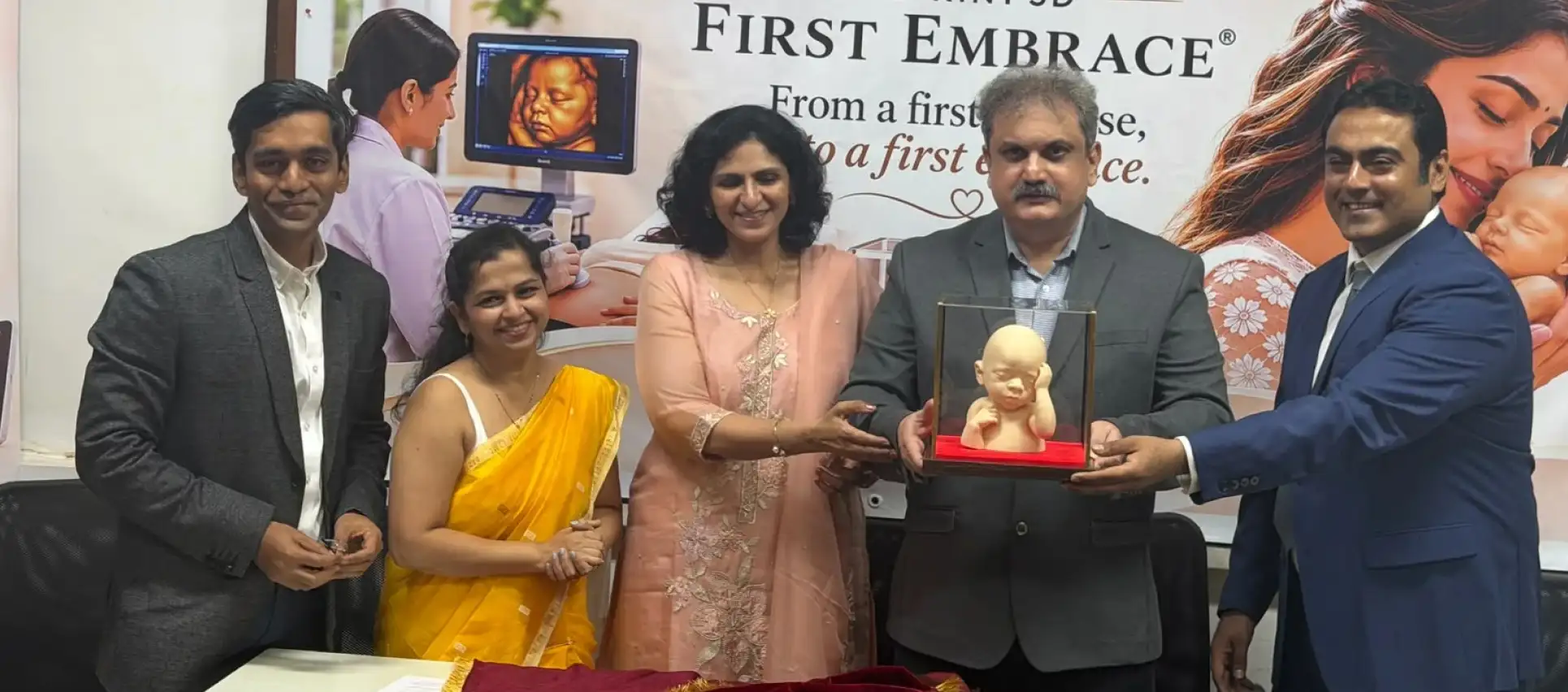
The service helps expectant parents preserve pregnancy memories through three-dimensional keepsakes, while the company is also developing anatomical models using suitable CT and MRI datasets for patient education and communication.
Mumbai-based medical technology venture LifePrint 3D has launched FirstEmbrace, a service that converts existing 3D and 4D ultrasound scans into personalized physical models of an unborn baby's face and upper body. The service helps expectant parents preserve pregnancy memories through three-dimensional keepsakes, while the company is also developing anatomical models using suitable CT and MRI datasets for patient education and communication.
Co-founded by radiologists Dr. Anand Bherwani, Dr. Sandesh Rothe and Dr. Sheetal Kabra, LifePrint 3D is bringing US-based medical imaging and 3D printing technology to India through its launch.
FirstEmbrace models are restricted to the baby's face and upper body. The service does not determine, reveal or communicate the sex of the foetus and will operate in accordance with the applicable provisions of the Pre-Conception and Pre-Natal Diagnostic Techniques (Prohibition of Sex Selection) Act, 1994 (PC&PNDT Act).
The company's anatomical modeling work currently focuses on education, demonstrations and patient communication with doctors. The models cover structures including the heart, lungs, airways, liver, kidneys, brain, spine, bones and vascular systems, helping make complex anatomy easier to visualize and understand.
Converting ultrasound data into physical models presents technical challenges, including image noise, shadows, foetal movements, variations in image quality and incomplete anatomical boundaries. These factors can make accurate three-dimensional reconstruction difficult and time-consuming.
Research has also examined the potential of 3D-printed fetal models in pregnancy care. An independent randomized controlled study published in the Journal of Obstetric, Gynecologic & Neonatal Nursing in 2020, involving 96 expectant mothers, found that participants who received 3D-printed models experienced an average improvement of 8.7 points in maternal-fetal attachment scores, compared with 4.9 points among those who received ultrasound images alone.
Dr. Sandesh Rothe, radiologist, co-founder and partner at LifePrint 3D, said, “For parents, these are moments that stay with a family forever. We want to give them an opportunity to preserve that memory in a completely different way, something they can actually hold. Importantly, we use scans that have already been performed as part of medical care, without encouraging unnecessary ultrasound examinations.”
Dr. Sheetal Kabra, radiologist, co-founder and partner at LifePrint 3D, explained the scientific challenges involved: “Every ultrasound scan is different. The baby's position, surrounding structures, acoustic shadows and the quality of the acquired images all influence how much detail can be reconstructed. Converting ultrasound data into a physical model is technically very different from simply printing a photograph. It requires careful assessment of the available anatomical information, image processing and three-dimensional reconstruction. Our focus is to preserve the visible features captured in the original scan while being transparent about the limitations of the technology.”
Dr. Anand Bherwani, radiologist, co-founder and partner at LifePrint 3D, said, “Artificial intelligence and advanced computational technologies are changing what we can do with medical images. What was once technically difficult and required extensive manual processing is gradually becoming more achievable. Our vision is to bring these advances together and make three-dimensional anatomical models more accessible. We are moving towards a future where medical imaging is no longer only about seeing. It is also about touching, understanding and connecting.”
FirstEmbrace is a non-medical, non-diagnostic personal keepsake. It does not replace medical imaging, clinical reports, professional interpretation or the judgment of a treating clinician and is not intended for medical assessment or decision-making.
Stay tuned for more such updates on Digital Health News
Follow us