From Scale to Systems: Mapping India’s Digital Health Progress Across States, 2026
India’s digital health transformation is entering a more consequential phase in 2026. Over the past few years, the country has built a large digital foundation through the Ayushman Bharat Digital Mission (ABDM), creating digital identities for citizens, registries for healthcare facilities and professionals, and the infrastructure needed to support interoperable and consent-based exchange of health information.
The scale is now substantial. As of July 20, 2026, India had created 94.87 crore Ayushman Bharat Health Accounts (ABHAs), while the Health Facility Registry (HFR) had 5.36 lakh registered facilities and the Healthcare Professionals Registry (HPR) had 10.09 lakh registered professionals. By July 2026, more than 100 crore health records had been linked with ABHAs, marking another major milestone for the country's digital health ecosystem.
Yet national numbers tell only part of the story. India's digital health transformation is increasingly being shaped by what individual states are doing with this infrastructure. The state-level picture reveals different pathways to digital-health maturity. Uttar Pradesh is driving absolute scale, Andhra Pradesh is demonstrating very high population-level ABHA saturation, Bihar has emerged as the leading state for Scan and Register digital OPD registrations, while Rajasthan and Gujarat demonstrate how existing state digital-health platforms can connect with the national ABDM architecture.
Tamil Nadu is extending ABDM integration into health insurance, Karnataka is using digital systems to support referrals, while Jammu & Kashmir and Ladakh illustrate why population-adjusted indicators can reveal dimensions of adoption that absolute numbers may miss.
The result is a digital-health landscape that is no longer adequately described by a single national leaderboard. India’s digital-health progress in 2026 is becoming a multi-dimensional story of scale, coverage, utilisation, interoperability and system integration.
India’s Digital-Health Foundation at a Glance
Before examining the states, it is important to understand the scale of the national infrastructure on which state-level digital health is now being built.
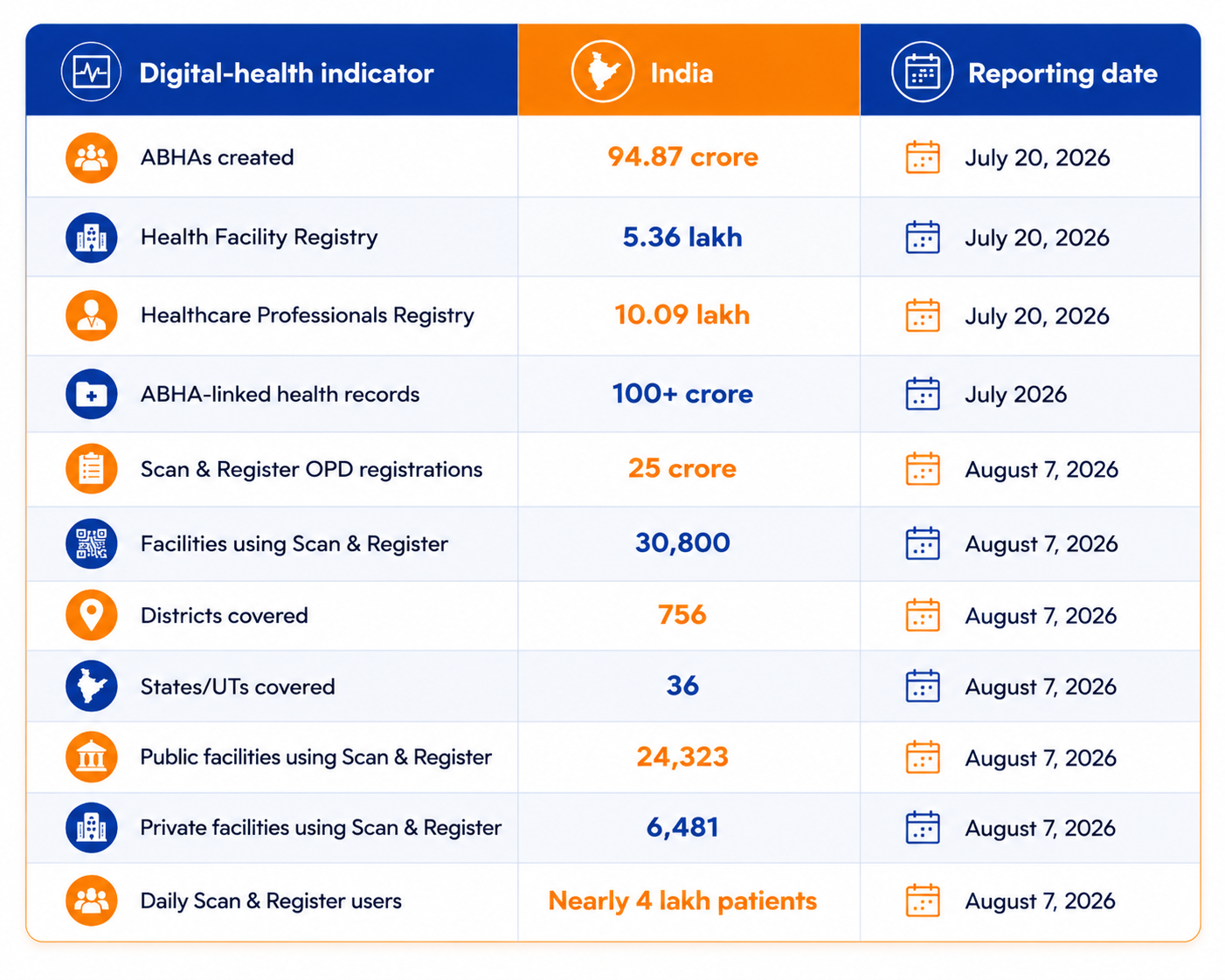
The figures come from different Government of India and National Health Authority reporting dates and should therefore be read with their respective reporting context.
The distinction between these indicators matters. ABHA creation measures the expansion of the digital identity layer, while HFR and HPR indicate the participation of healthcare facilities and professionals in the national digital ecosystem. ABHA-linked records provide an indicator of digital health-record activity, while Scan and Register offers a more direct measure of patient-facing digital service utilisation.
ABDM's architecture is also designed around interoperability and consent. The government has described ABDM as an ecosystem that facilitates secure exchange of health information between intended stakeholders with patient consent rather than operating as a centralised repository of citizens' health data.
Uttar Pradesh: India’s Scale Leader Moves Towards System Integration
Uttar Pradesh sits at the centre of India’s digital-health scale story. The state had created more than 15.3 crore ABHAs by May 2026, the highest among states. It also emerged as the leading contributor to India's ABHA-linked health records, with more than 15.03 crore records linked at the country's 100-crore milestone.
The larger significance of Uttar Pradesh's progress is that the state is moving beyond digital identity creation. Its eKavach platform has been integrated with ABDM, providing an example of how state-specific digital health systems can connect with the national architecture.
The state’s adoption of citizen-facing digital services provides another indication of this transition. By August 7, Uttar Pradesh had recorded 4.09 crore Scan and Register transactions, making it the second-highest state nationally. This provides an indication of growing use of digital infrastructure at the point where patients enter the healthcare system.
Uttar Pradesh at a glance
- 15.3+ crore ABHAs created by May 2026
- 15.03+ crore ABHA-linked records at the 100-crore national milestone
- 4.09 crore Scan and Register transactions by August 7
- eKavach integrated with ABDM
Andhra Pradesh: High Population Coverage
Andhra Pradesh presents a different model of digital-health progress. The state recorded 98.5% ABHA saturation in the Ministry's May 2026 data, placing it among the strongest-performing large states and Union Territories on population coverage.
It also recorded more than 11.95 crore ABHA-linked health records at the national 100-crore milestone.
The state’s performance becomes even more significant when digital utilisation is considered. Andhra Pradesh had recorded more than 3.38 crore Scan and Register transactions by August 7, placing it third nationally.
The combination of high saturation and high service utilisation illustrates an important dimension of digital-health maturity: moving from ensuring that citizens have digital identities towards incorporating those identities into healthcare interactions.
Bihar: Where Digital Health Reaches the OPD
Bihar's digital-health story is particularly significant because of its performance in Scan and Register. The state had created 6.3 crore ABHAs by May 2026 and recorded more than 7.37 crore ABHA-linked health records at the national 100-crore milestone.
Its strongest indicator in 2026, however, is patient-facing utilisation. Bihar recorded more than 7.30 crore Scan and Register transactions by August 7, the highest among all states and Union Territories.
This is an important shift in the digital-health narrative. Creating an ABHA is an infrastructure milestone, while a completed digital OPD registration provides a stronger indicator of service utilisation.
Nationally, Scan and Register crossed 25 crore OPD registrations by August 7 and was operational across 30,800 healthcare facilities, 756 districts and all 36 States and Union Territories.
What Bihar’s numbers demonstrate
- Digital identity creation
- High-volume digital OPD registration
- Citizen-facing utilisation
- Large-scale implementation across healthcare facilities
Bihar therefore provides an important example of how digital-health infrastructure can become part of everyday healthcare operations.
Rajasthan: Connecting State Platforms to National Infrastructure
Rajasthan's digital-health journey combines scale, population coverage and interoperability. The state had created 7.1 crore ABHAs, with 89.7% ABHA saturation, by May 2026. More than 6.32 crore health records had been linked with ABHAs.
The more strategic development is the integration of Rajasthan's Pregnancy, Child Tracking and Health Services Management System (PCTS) with ABDM. The Ministry has listed PCTS among state and national digital-health platforms integrated with ABDM.
Rajasthan was also honoured at the April 2026 NHA Chintan Shivir in Pune for maximum registration of private healthcare professionals and facilities under ABDM.
This is significant because a national digital-health ecosystem cannot be built through government facilities alone. Private hospitals, clinics and healthcare professionals represent a substantial part of healthcare delivery, making their participation important to building a connected ecosystem.
Maharashtra and West Bengal: Population Scale Remains Important
Maharashtra and West Bengal are among the largest contributors to India's digital-health identity ecosystem. Maharashtra had created approximately 7.1 crore ABHAs, while West Bengal had created 5.9 crore by May 2026.
However, these figures also demonstrate why state-level comparisons need context. Absolute numbers naturally favour larger populations. A more complete comparison therefore needs to combine absolute ABHA creation with saturation, health-record linkage, facility participation and service utilisation.
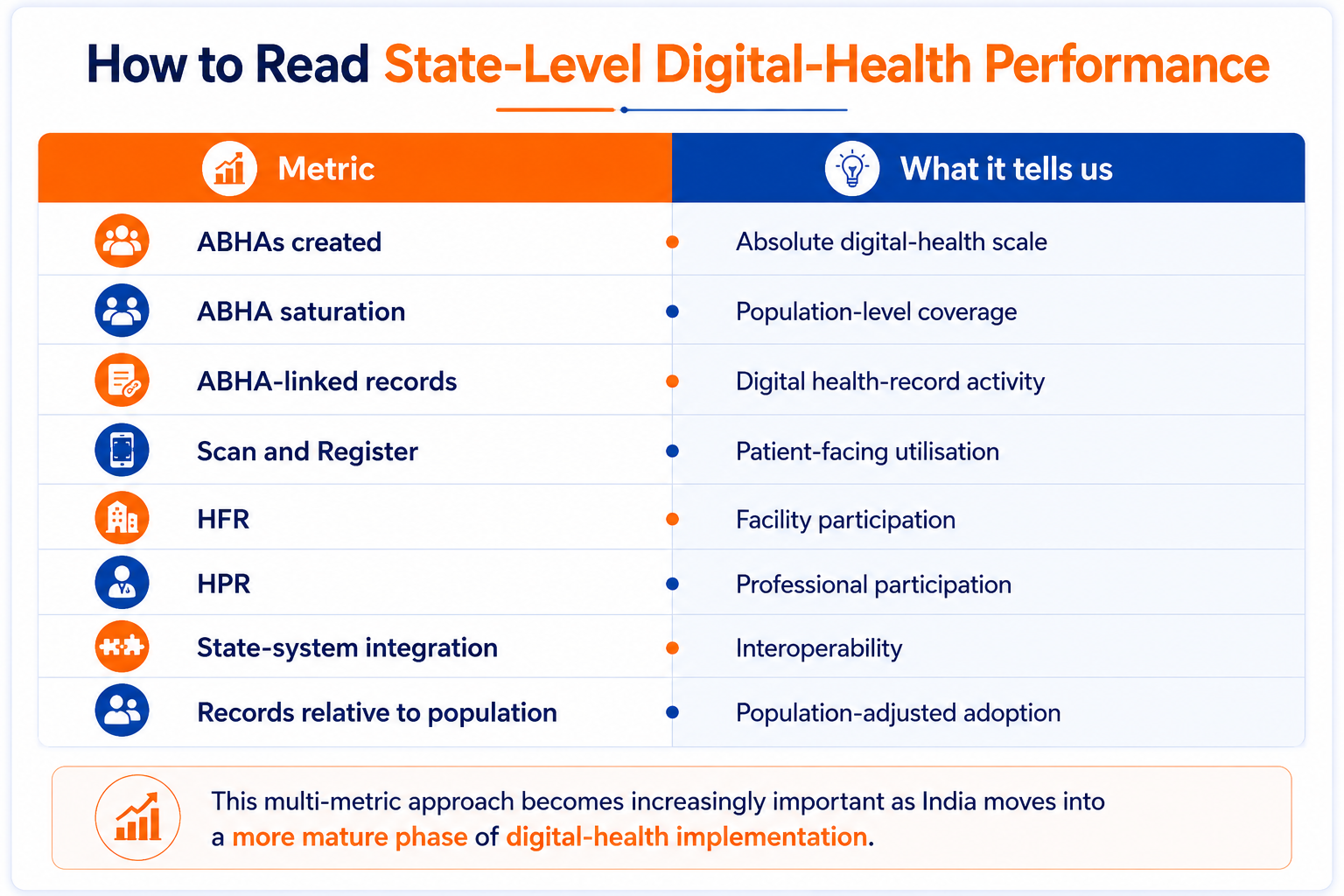
This multi-metric approach becomes increasingly important as India moves into a more mature phase of digital-health implementation.
Gujarat: Interoperability as the Next Frontier
Gujarat's experience highlights the importance of connecting state-developed platforms with ABDM. The state had contributed more than 4.77 crore ABHA-linked health records at the national 100-crore milestone.
Its TeCHO platform has also been integrated with ABDM, providing another example of state-level digital infrastructure connecting with the national ecosystem.
The importance of such integration goes beyond technology. India's healthcare system operates through a complex combination of central programmes, state health departments, public hospitals, private providers and specialised health platforms. A common interoperability architecture can allow these systems to remain tailored to local requirements while participating in a broader digital-health ecosystem.
Madhya Pradesh: Digital Adoption at the Institutional Level
Madhya Pradesh offers a useful institutional perspective on digital-health adoption. The clearest example is AIIMS Bhopal, which had recorded 29.10 lakh Scan and Register OPD registrations by August 7, 2026, making it the second-highest government facility nationally after AIIMS New Delhi.
The importance of this number lies in its connection to hospital operations. Digital health becomes meaningful when technology is incorporated into everyday workflows used by patients and healthcare workers. High-volume digital registration at a major public hospital therefore provides an example of national digital infrastructure being translated into operational healthcare delivery.
Odisha, Himachal Pradesh and Chhattisgarh: Strong Coverage Across Diverse Geographies
Several states demonstrate the breadth of India's digital-health penetration through high ABHA saturation. Odisha recorded 91.9% saturation, Himachal Pradesh 88.9%, and Chhattisgarh 86.6% in the Ministry's May 2026 assessment.
These figures demonstrate why population coverage is an important complement to absolute ABHA numbers. While states such as Uttar Pradesh lead absolute numbers because of their population size, states with high saturation demonstrate how deeply digital health has penetrated their populations.
Chhattisgarh also featured prominently in the April 2026 NHA Chintan Shivir. It was recognised for timely processing of suspicious claims, while Jharkhand, Chhattisgarh and Madhya Pradesh were jointly recognised for best performance among large states in high-trigger efficacy under AB PM-JAY.
Tamil Nadu: Bringing Health Insurance into the Digital-Health Ecosystem
Tamil Nadu illustrates the expanding scope of ABDM through the integration of its Comprehensive Health Insurance Scheme (CMCHIS) with the national digital-health ecosystem.
This is important because healthcare is not limited to clinical interactions. A patient journey can involve registration, consultation, diagnostics, hospitalisation, referral, treatment and insurance claims. Connecting health-financing infrastructure with digital-health architecture can therefore create a broader ecosystem in which clinical and administrative processes can increasingly operate through connected digital workflows.
Karnataka: Digital Referrals and Continuity of Care
Karnataka provides another example of digital infrastructure being used to support healthcare workflows. At the April 2026 NHA Chintan Shivir, the state presented its online referral system for PM-JAY beneficiaries.
Digital referral systems are particularly relevant because healthcare is distributed across multiple levels. Patients may move from primary care to secondary or tertiary facilities, and digital referral infrastructure can support information exchange and continuity across those transitions.
Tripura: Digital Transformation Also Depends on People
Technology infrastructure is only one side of digital-health transformation. Healthcare workers, administrators and citizens must also be equipped to use digital systems effectively.
Tripura was recognised at the April 2026 NHA Chintan Shivir in Pune as the top-performing state for IEC and capacity-building activities under ABDM.
This highlights an important component of implementation that can be overlooked in technology-focused discussions. Training, awareness and organisational preparedness can influence whether digital infrastructure becomes part of routine healthcare delivery.
As India's digital-health ecosystem becomes more sophisticated, these capabilities will become increasingly important.
Smaller Union Territories: The Saturation Story
The digital-health map changes considerably when smaller Union Territories are included. The Ministry's May 2026 data reported full ABHA saturation in Andaman and Nicobar Islands, Ladakh, Lakshadweep, and Dadra and Nagar Haveli and Daman and Diu.
The July 2026 NHA National Review Meeting also recognised States and Union Territories for excellence in ABDM implementation, reinforcing the importance of registry saturation and adoption across different jurisdictions.
These examples demonstrate that comprehensive digital-health coverage can be achieved across smaller and more defined populations and provide useful implementation models for understanding what high-level saturation can look like.
State-Wise Digital-Health Map: The Bigger Picture
State/UT | Key digital-health signal in 2026 | What it illustrates |
Uttar Pradesh | 15.3+ crore ABHAs; 4.09 crore Scan and Register transactions | Scale + utilisation |
Andhra Pradesh | 98.5% ABHA saturation; 3.38 crore Scan and Register transactions | Population coverage + utilisation |
Bihar | 7.30+ crore Scan and Register transactions | Patient-facing adoption |
Rajasthan | 89.7% saturation; PCTS integration | State-system interoperability |
Maharashtra | ~7.1 crore ABHAs | Population-scale adoption |
West Bengal | ~5.9 crore ABHAs | Population-scale adoption |
Gujarat | TeCHO integration; 4.77+ crore linked records | Interoperability |
Madhya Pradesh | AIIMS Bhopal: 29.10 lakh Scan and Register transactions | Institutional adoption |
Odisha | 91.9% saturation | High population coverage |
Himachal Pradesh | 88.9% saturation | High population coverage |
Chhattisgarh | 86.6% saturation; AB PM-JAY recognition | Coverage + health-assurance digitisation |
Tamil Nadu | CMCHIS integrated with ABDM | Digital health + financing |
Karnataka | Online PM-JAY referral system | Digital referrals |
Jammu & Kashmir | ABDM implementation and population-adjusted adoption | Population-adjusted adoption |
Ladakh | ABDM implementation and high digital adoption | Population-adjusted adoption |
Tripura | Top-performing state for IEC and capacity building | Human/organisational readiness |
Smaller UTs | Several achieving full ABHA saturation | Comprehensive coverage |
Note: These indicators come from different Government/NHA reporting dates and should not be interpreted as a single-day ranking.
Five Dimensions of India’s Digital-Health Progress
The following is an editorial analytical framework, not an official NHA classification.
The state-level evidence suggests five increasingly important dimensions through which digital-health maturity can be assessed:
1. Scale
How many citizens, facilities, and professionals are connected to the digital ecosystem?
2. Coverage
What proportion of a state's population has been incorporated into the digital-health identity layer?
3. Utilisation
Are citizens actually using digital services during healthcare encounters?
4. Interoperability
Can state-developed platforms and national systems communicate through common standards?
5. System integration
Are digital health records, referrals, insurance, and other healthcare workflows beginning to operate as connected components?
This framework provides a broader way to interpret India's progress than simply ranking states by the number of ABHAs created.
From ABHA Creation to an Integrated Health Ecosystem
The following three-stage model is an editorial analytical framework, not a formal Government of India classification.
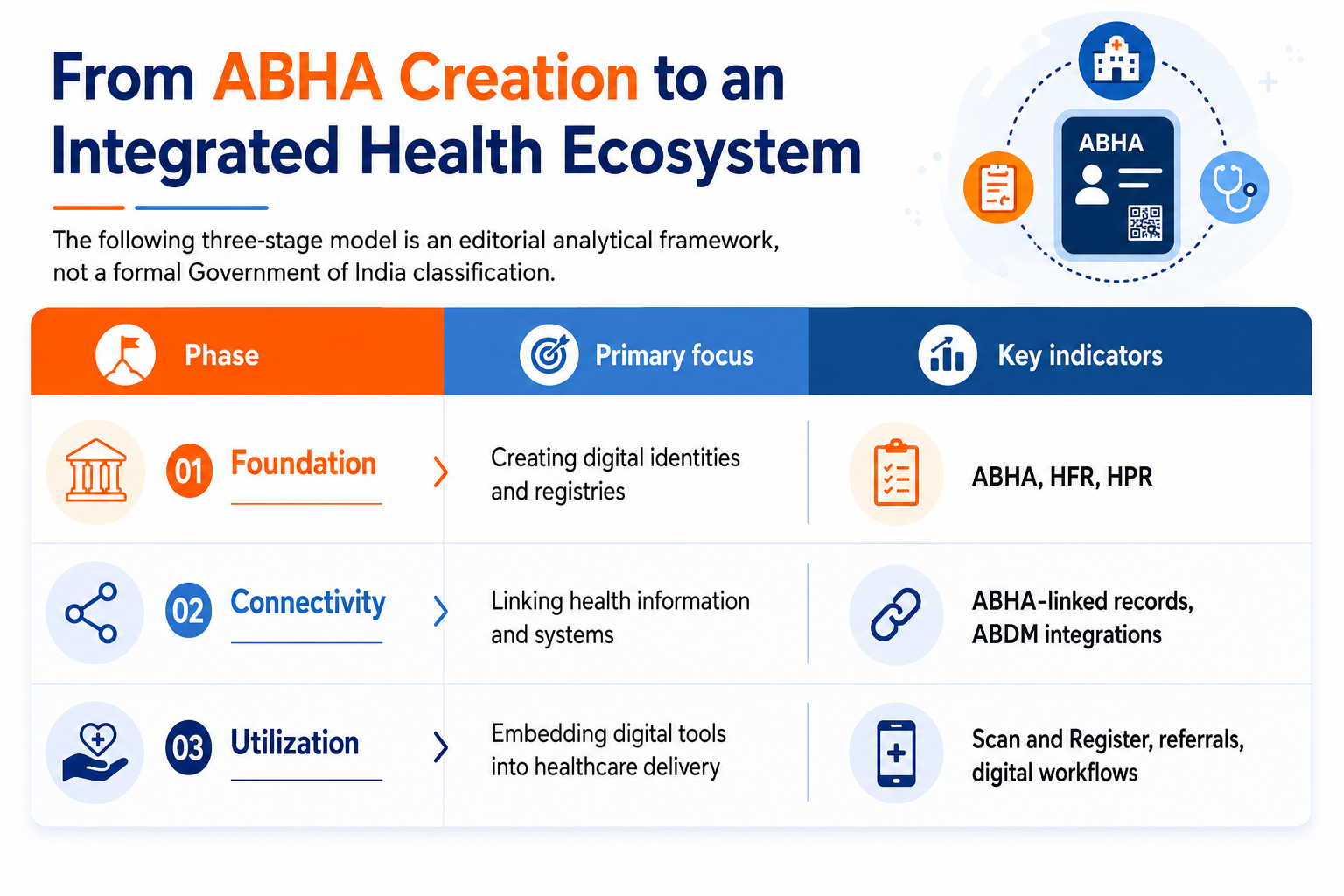
India is now operating across all three layers simultaneously. The foundation continues to expand, connectivity is deepening through state-platform integrations and health-record linkage, and utilisation is becoming increasingly visible through services such as Scan and Register.
That makes 2026 an important point in India's digital-health journey.
The Next Frontier: From Connected Data to Connected Care
The next phase of India's digital-health transformation will increasingly depend on what happens after the infrastructure has been created.
The July 2026 NHA National Review Meeting highlighted wider adoption and effective utilisation of digital-health initiatives, with discussions covering AI, health analytics, interoperability and evidence-based decision-making. The meeting also reviewed digital initiatives including the National Health Claims Exchange, Ayushman App and other ABDM-enabled services.
The July meeting also featured an AIIMS New Delhi presentation on the implementation of a Clinical Decision Support System, highlighting the role of artificial intelligence in supporting evidence-based clinical decision-making.
This suggests that the conversation is gradually moving from simply creating and connecting digital information towards using that information more effectively.
For states, this could mean deeper integration of health platforms, wider participation from private providers, stronger digital referral systems, improved record continuity and greater use of health data for planning and decision-making.
The diversity of India's states could become an advantage in this phase. Different states are already demonstrating different strengths: some have achieved high population coverage, others have developed strong digital-service utilisation, while others are integrating established state platforms with ABDM.
The national architecture provides a common layer through which these different approaches can increasingly connect.
Conclusion: The States Are Shaping India’s Next Digital-Health Chapter
India's digital-health journey has moved far beyond the initial task of creating digital identities. With 94.87 crore ABHAs, 5.36 lakh registered health facilities and 10.09 lakh registered healthcare professionals as of July 20, 2026, the country has established a digital-health foundation operating at national scale. More than 100 crore health records had also been linked with ABHAs by July 2026.
But the more consequential story is emerging at the state level.
Uttar Pradesh demonstrates the power of scale; Andhra Pradesh shows what near-universal digital-identity coverage can look like; Bihar is demonstrating high-volume patient-facing adoption; Rajasthan and Gujarat are showing how state systems can connect with ABDM; Tamil Nadu is extending digital integration into health financing; Karnataka is applying digital infrastructure to referrals; Madhya Pradesh is demonstrating institutional adoption through AIIMS Bhopal; and Tripura highlights the importance of IEC and capacity building in digital-health implementation.
The result is not a uniform digital-health landscape. It is a federated ecosystem in which states are pursuing different pathways while increasingly connecting to a common national architecture.
That distinction will become increasingly important in the years ahead.
The first question was whether India could digitise healthcare at scale. The data of 2026 provides a strong indication that it can.
The more consequential question now is how effectively those digital components can work together.
Can a citizen's digital identity connect with healthcare records? Can those records be shared across participating providers with appropriate patient consent and interoperability? Can referrals become digitally connected? Can state health platforms communicate with national systems? Can insurance and clinical workflows increasingly intersect? And can the enormous volume of digital information being generated across India's healthcare system support better planning, decision-making and care delivery?
These questions define the next stage of India's digital-health journey.
The country has built the scale. The states are now helping turn that scale into systems and increasingly, those systems into connected healthcare.
Stay tuned for more such updates on Digital Health News
Follow us